










Setting the table: the rules of the place setting and why the tabletop has a say
Where cutlery, glasses, napkin and bread plate go follows a simple logic. How it can be applied on a metal table and what the tabletop itself dictates.

In brief
- Setting a table follows a logic: the plate stands in the centre of the place, and the cutlery lies in the order of the menu from the outside in.
- Forks lie on the left, knives and soup spoon on the right, with the knife blades facing the plate; the dessert cutlery lies above the plate.
- The glasses stand to the upper right of the knives, the bread plate on the left, the napkin on the plate or to the left of the forks.
- A metal tabletop is itself part of the place setting: placemats or a runner protect the sealed surface, and hot dishes stand on trivets.
- For guests, breakfast or coffee, the same order becomes shorter or longer, but its logic remains.
Contents
Setting the table is regarded as a chore before a meal, yet it is a small composition. Every piece has its place, and that place is not arbitrary: it follows the order in which the meal is eaten and the hand that reaches for it. Once you have understood this logic, you no longer need a chart to know where the fork goes.
This article describes the rules that apply to every set table, from cutlery and glasses to the napkin, and how they can be applied on a metal tabletop. What makes the table festive over the holidays is covered in the article on the Christmas table.
Setting the table: the basic order of the place setting
The place setting is the place of a single guest: plate, cutlery, glass and napkin. At its centre is the plate, set a little back from the edge of the table so that forearms have room. To its left lie the forks, to its right the knives and the soup spoon, above it the dessert cutlery. The glasses stand at the upper right, the bread plate on the left [2].
- Plate: centre of the place
- Forks: left, knives and spoons: right
- Glasses: upper right, bread plate: left
There is a simple reason for this order. Most people cut with their right hand and hold the fork in their left, so every piece lies where the hand looks for it. Most people also drink with their right hand, which is why the glasses stand on that side. What is often called the rules of etiquette is, at its core, an order of movement.
For everyday use, a simple version is enough: one plate, knife and fork, one glass, one napkin. Setting the table this way is setting it correctly, because the rules only grow with the number of courses. A place setting for three courses needs more cutlery, but no different logic. Each place should hold only what will actually be needed during the meal.
Where the rules come from matters less than their effect. A table at which every place setting shows the same order looks calm before the first dish arrives. Equal spacing between places, plates in a line, cutlery parallel to the edge of the table: the result is a picture that can be recognised from the doorway.
Laying cutlery correctly: from the outside in
The most important rule for cutlery is that it is laid in the order of the menu from the outside in [2]. What is needed first lies furthest from the plate, what comes last lies right next to it. That way, with every course the guest reaches for the outermost piece and never has to think about it.
- Order: from the outside in
- Knife: blade facing the plate
- Dessert: above the plate
For a menu of soup, main course and dessert, the soup spoon lies on the far right, the knife for the main course inside it, and the fork on the left. If there is a starter, the starter knife and starter fork are each added on the outside [2]. The knife blades face the plate, and the cutlery lies about one centimetre from the rim of the plate [3]. Dessert spoon and dessert fork lie horizontally above the plate, the spoon with its handle to the right, the fork below it with its handle to the left [3].
More than three pieces of cutlery on each side overwhelm any place. With five courses, cutlery is therefore added as the meal goes on rather than putting everything on the table at once. If you want to lay the cutlery on the napkin, place the napkin folded to the left of the plate and the forks on top of it. On a metal tabletop, cutlery in this order looks like a drawing: parallel lines, equal spacing, a clear edge.
Glasses, napkin and bread plate
The glasses stand to the upper right of the knives and, like the cutlery, are set in the order in which they are used [2]. The anchor is the glass for the main course, which stands above the tip of the main course knife. The water glass belongs to every place setting; wine and sparkling wine glasses are added according to the menu. More than four glasses per place are rarely needed.
- Glasses: upper right, above the knives
- Napkin: on the plate or on the left
- Bread plate: on the left, with its own knife
The napkin lies on the plate as long as the plate is empty. If the first course is already at the place, it moves to the left next to the forks or onto the bread plate [2]. This also answers whether it belongs on the right or the left: on the left it does not get in the way of a hand reaching for a glass. A simply folded fabric napkin looks calmer on any table than an elaborate figure.
The bread plate stands on the left, beside or above the forks, with a small bread knife on it [2]. It is not a decorative piece but has a task that becomes more important on a metal table than anywhere else: bread and butter lie on it and not on the tabletop. A salad plate, if needed, also goes on the left-hand side.
During the meal the glasses are not moved around. If a drink has been finished and no other follows, the glass is cleared together with the course it belonged to. In this way only what is still needed remains at the upper right, and the place becomes a little emptier with each course.
Why the tabletop helps define the rules
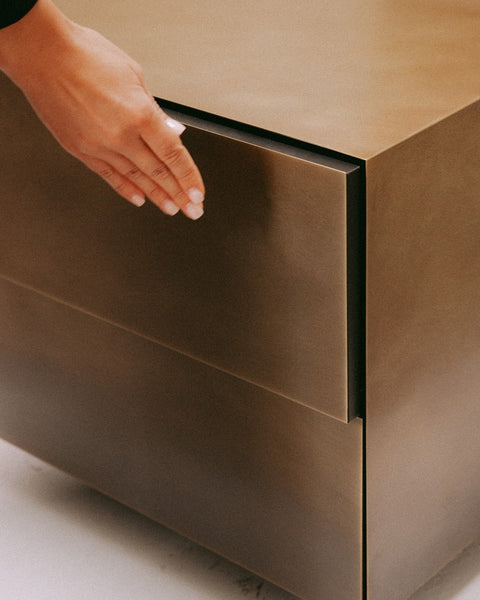
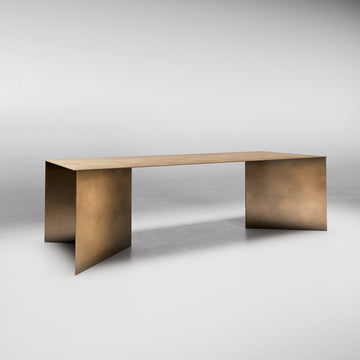
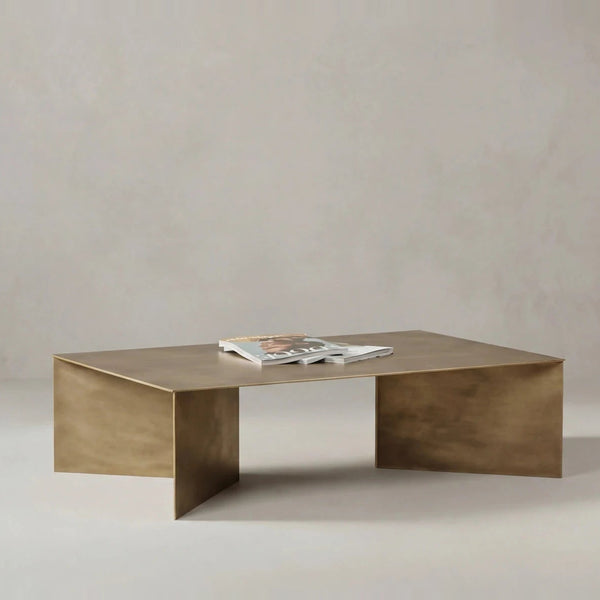
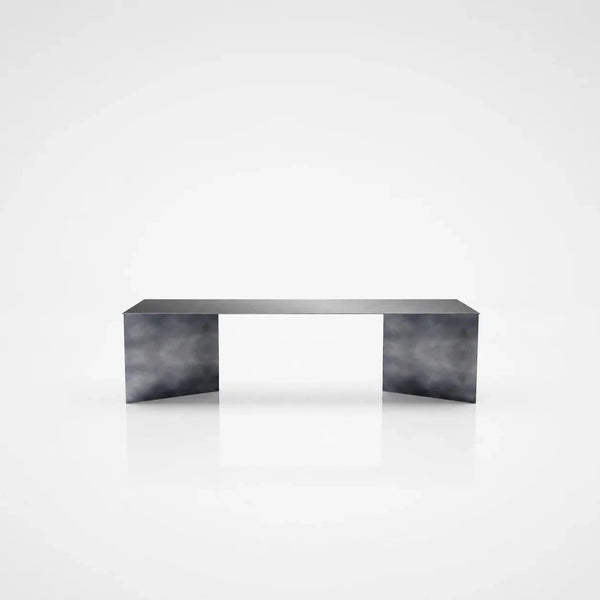
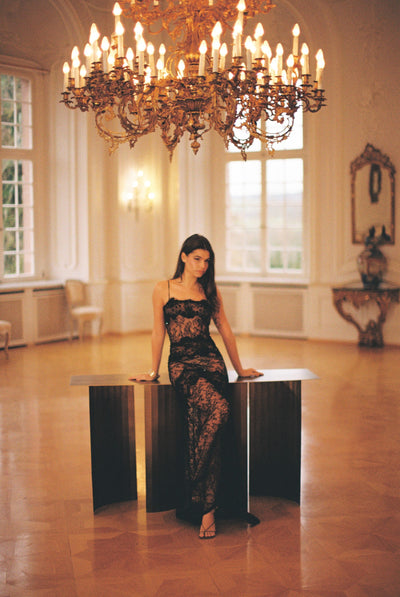
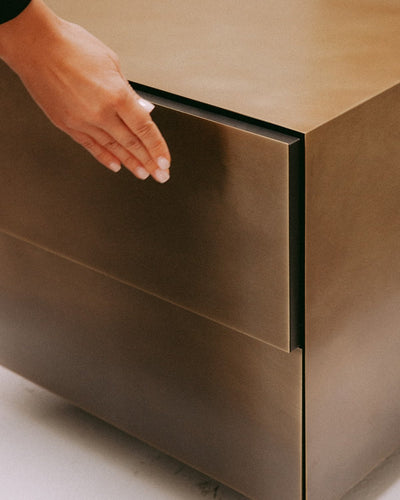
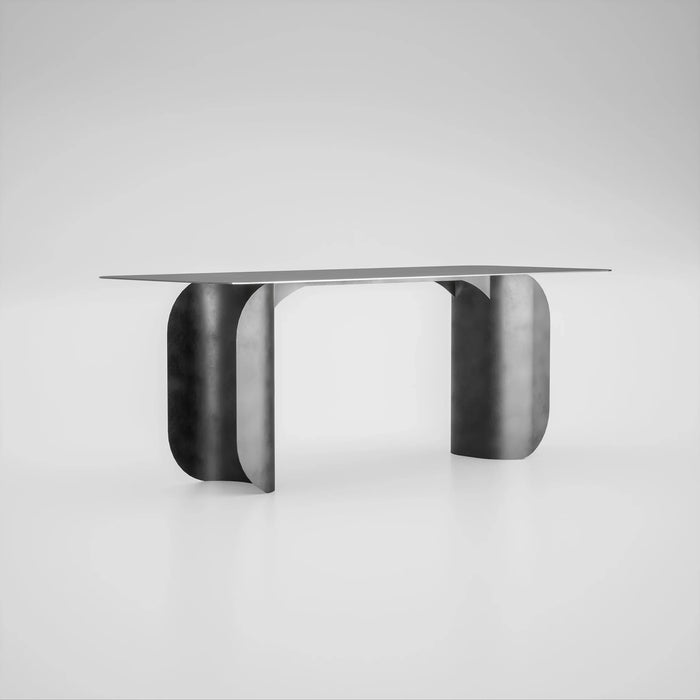
The rules for setting a table date from a time when a tablecloth was taken for granted. On a metal tabletop the order of the place setting applies unchanged, but the surface itself has a say. ZEN DINING TABLE and SAMURAI have tops of brushed stainless steel, the ZEN DINING TABLE also in burnished brass, and both are sealed with 2K clear lacquer [1].
- Placemat or runner: under plate and cutlery
- Trivets: under anything hot
- Bread: on the bread plate, not on the tabletop
The sealing protects the surface but does not make it scratch-proof, as the care instructions point out [4]. A placemat of linen, felt or leather under each place setting therefore takes the plate and cutlery and at the same time frames the place. Hot pots and baking dishes get a trivet, because according to the care instructions hot objects are not placed directly on the surface [4]. Anything spilled is wiped up promptly.
This also answers whether such a table needs a tablecloth. It does not, because what defines it would disappear underneath. Brushed stainless steel lays a fine grain beneath the place setting that makes glasses and cutlery look cool and precise; burnished brass gives them a warm ground. Setting the table without a tablecloth here means treating the tabletop as part of the place setting.
The choice of tableware also follows the surface. White porcelain and clear glass stand out particularly clearly on brushed stainless steel, while dark ceramics and linen in sand or rust suit burnished brass. Silver-coloured cutlery works with both tops; cutlery in a brass tone repeats the tone of the surface on a brass table.
Mentioned in this article
Pieces from this article.

The set table for guests, breakfast and coffee
Setting a table for guests means, first of all, giving them space. Every guest needs room for elbows and glasses, and there should be free surface between the places. SAMURAI measures 200 × 80 cm and, according to the product page, seats up to eight people [1]; if you plan for six place settings, you gain on the same top the breathing space that makes a set table look calm.
- Guests: space before completeness
- Breakfast: plate, knife, cup
- Coffee: cake fork, cup, saucer
The breakfast table is set sparingly: breakfast plate, knife, possibly a spoon, and at the upper right a cup with saucer and a glass for juice. For coffee and cake, the cake fork lies to the right of the plate or across it, and the cup stands at the upper right. Both follow the same logic as the evening place setting, only shorter.
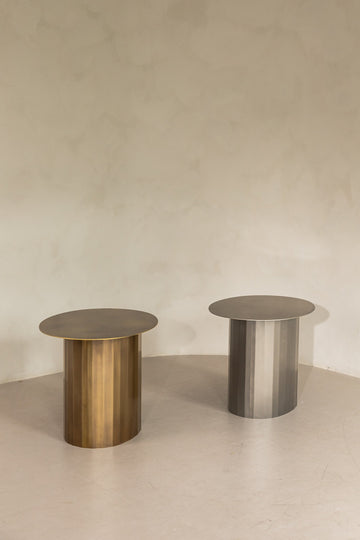
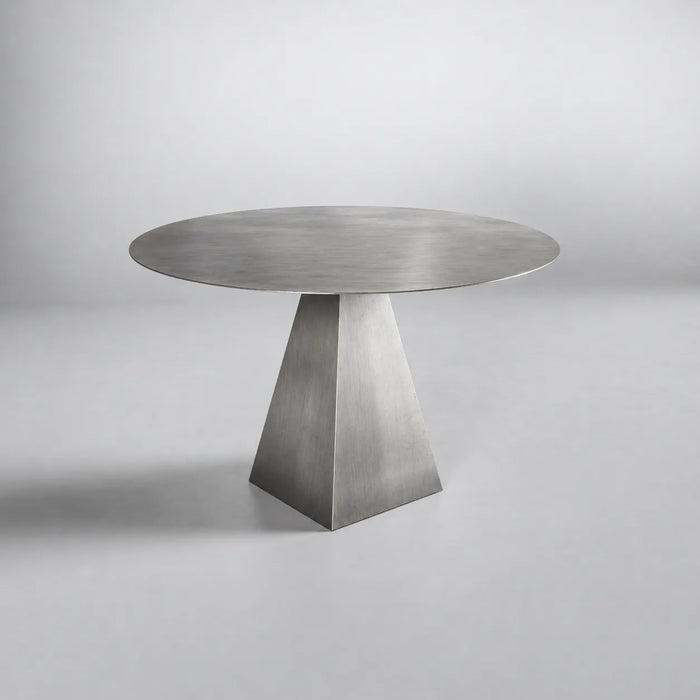
Setting a round table has an advantage of its own: all the guests can see each other, and the centre belongs to everyone. At PYRAMID TABLE, 124 cm in diameter, the place settings are distributed evenly in a circle [1]. Such a table looks beautifully set when the pieces of each place setting match and the centre remains free. More shapes can be found in the overview of dining tables.
For a stylishly set table, this order is enough. Ideas for decoration and colour only begin once every place setting is right, and they are subordinate to it: whatever goes in the centre stays low and leaves the surface between the places free.
A well-set table hardly stands out. No one looks for the fork, no one knocks over a glass, and there is so much surface between the places that the meal has room. The rules for this are older than any piece of furniture on which they are applied.
On a metal tabletop they take on a second meaning. There, the place setting not only orders the meal, it draws on the surface, and the surface responds with light.
Frequently asked questions
How do you set a table correctly?
The plate stands in the centre of the place, and the cutlery lies in the order of the menu from the outside in: forks on the left, knives and soup spoon on the right, knife blades facing the plate, dessert cutlery horizontally above the plate. The glasses stand to the upper right of the knives, the bread plate on the left, the napkin on the plate or to the left of the forks. For everyday use, plate, knife, fork, glass and napkin are enough.
Where does the spoon go when setting the table?
The soup spoon lies on the far right next to the knives, because soup is usually eaten first. The dessert spoon lies horizontally above the plate, with its handle to the right. A coffee spoon belongs on the saucer, to the right of the cup handle.
Where does the napkin go when setting the table?
On the empty plate. If the first course is already there, it lies to the left of the forks or on the bread plate. On the right-hand side it gets in the way of the hand reaching for the glasses.
Does the knife go to the left or the right of the plate?
On the right, with the blade facing the plate. Forks lie on the left. This order follows the hand that cuts during the meal; anyone who eats left-handed can swap knife and fork at their own place.
In what order are the glasses placed?
The glasses stand to the upper right of the knives and, like the cutlery, follow the order in which they are needed. The glass for the drink served with the main course stands above the tip of the main course knife, and the other glasses are grouped next to it. A water glass belongs to every place setting; more than four glasses per place are rarely necessary.
Does the bread plate go on the right or the left?
On the left, beside or above the forks, with a small bread knife on it. A salad plate also goes on the left-hand side. On a dining table with a sealed metal top, the bread plate has the additional task of keeping bread and butter off the surface.
Does a metal dining table need a tablecloth?
No. A top of brushed stainless steel or burnished brass is itself part of the place setting. ZinCuTec dining tables are sealed with 2K clear lacquer; the sealing protects but does not make the surface scratch-proof. Placemats of linen, felt or leather under each place setting and trivets for hot pots are therefore advisable.
Sources & references
- [1]ZinCuTec GmbH: Produktangaben ZEN DINING TABLE, SAMURAI und PYRAMID TABLE (Maße, Material, Oberfläche, Platzangabe SAMURAI), zincutec.eu, abgerufen am 11.10.2026
- [2]lecker.de: Tisch eindecken: so geht's richtig, abgerufen am 11.10.2026 lecker.de/tisch-eindecken-so-gehts-richtig-49497.html
- [3]g-wie-gastro.de: Besteck eindecken (Glossar Gastro-Wissen), abgerufen am 11.10.2026 g-wie-gastro.de/mehr-zur-gastronomie/glossar/gastro-wissen-allgemein/besteck-eindecken/
- [4]ZinCuTec GmbH: Gewährleistung & Pflege, Gewährleistungs- und Pflegehinweise (Stand 10. Juli 2026), abgerufen am 11.10.2026 zincutec.eu/pages/pflege
How we work: journal articles are written in the workshop, checked by a specialist before publication and updated when something changes. Editorial principles
Read on
You might also like.

Setting a festive Christmas table: brass instead of gold, calm instead of abundance
A Christmas table feels festive when the tabletop stays visible and a few things are given weight. How place settings, centrepiece, colour and candlelight come together without overloading the table.Read article
Designing the hallway: why the first room is the home’s underrated statement
A hallway is a path, a space for light and a place to set things down, all at once. The principles that bring it into order, and how furniture, colour, light and a single object turn a passage into a room.Read article