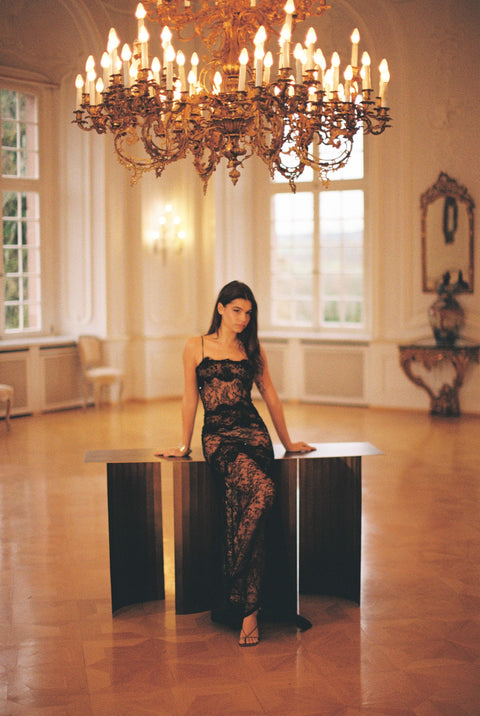
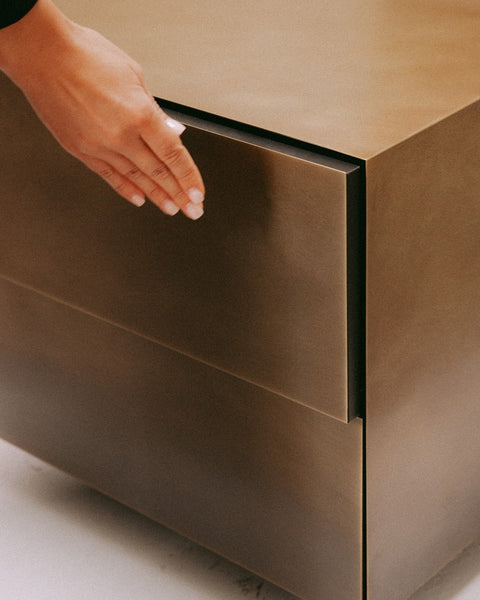
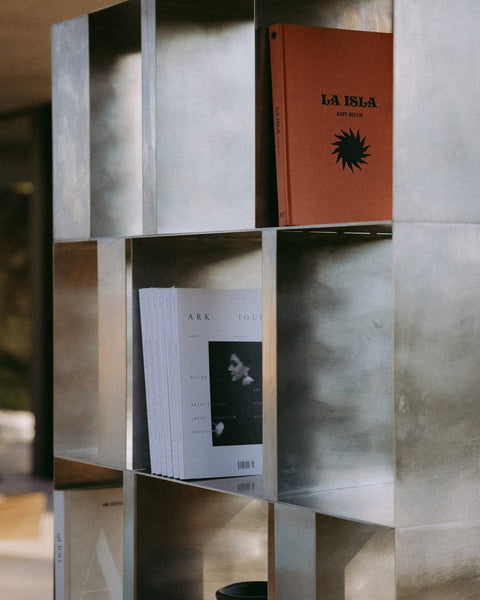
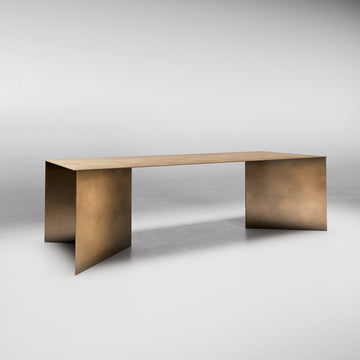
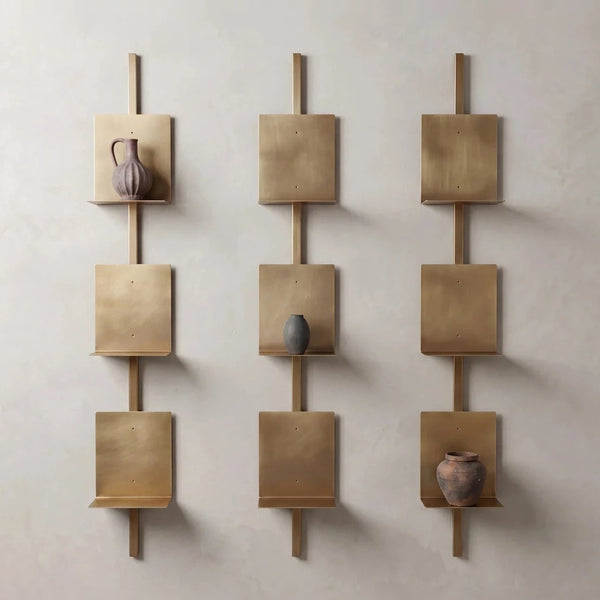
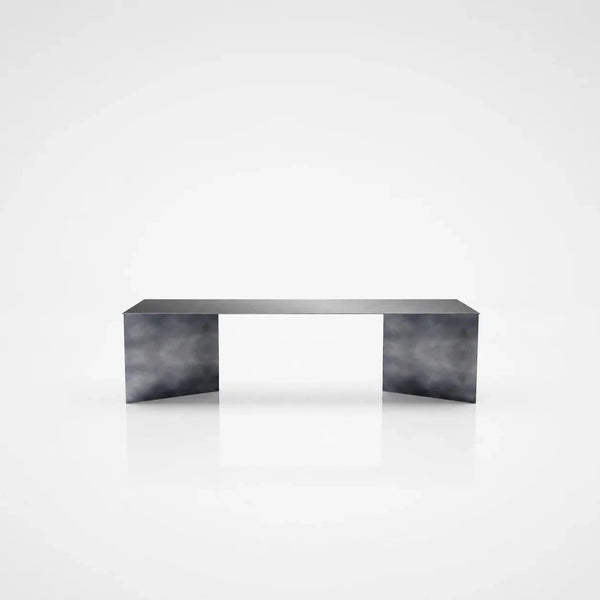
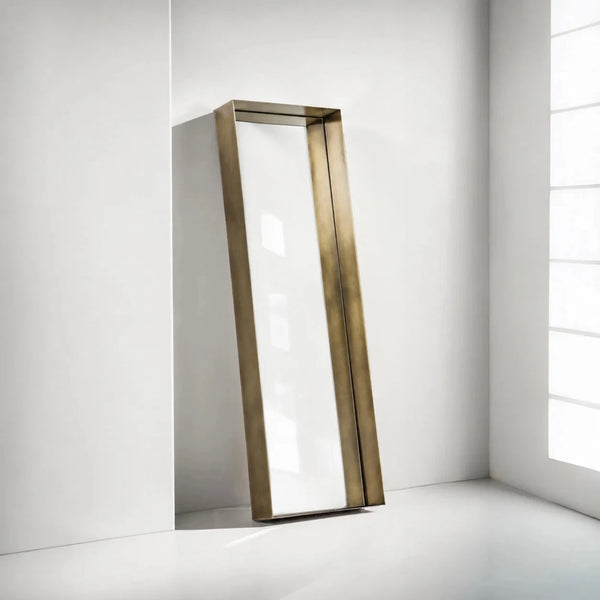
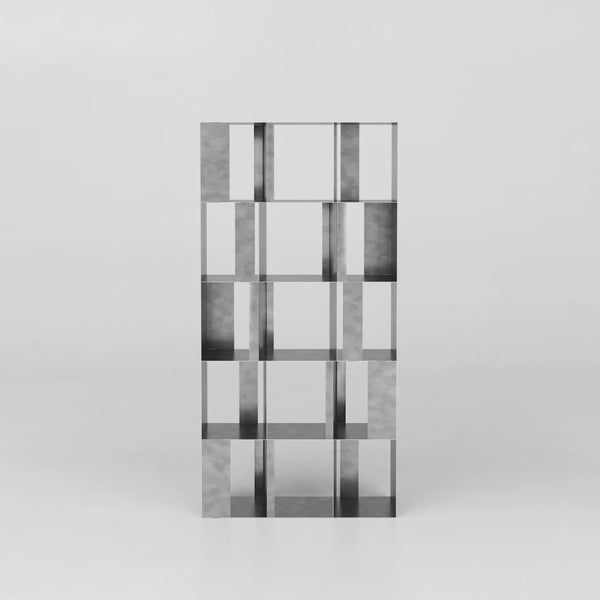
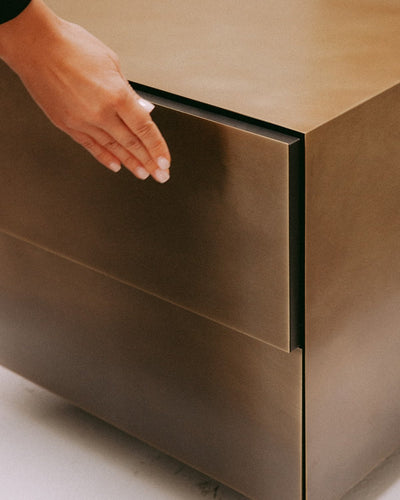
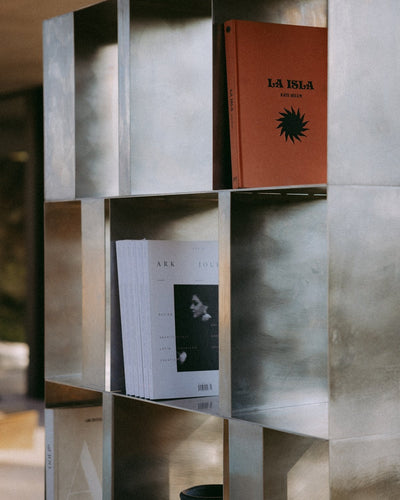
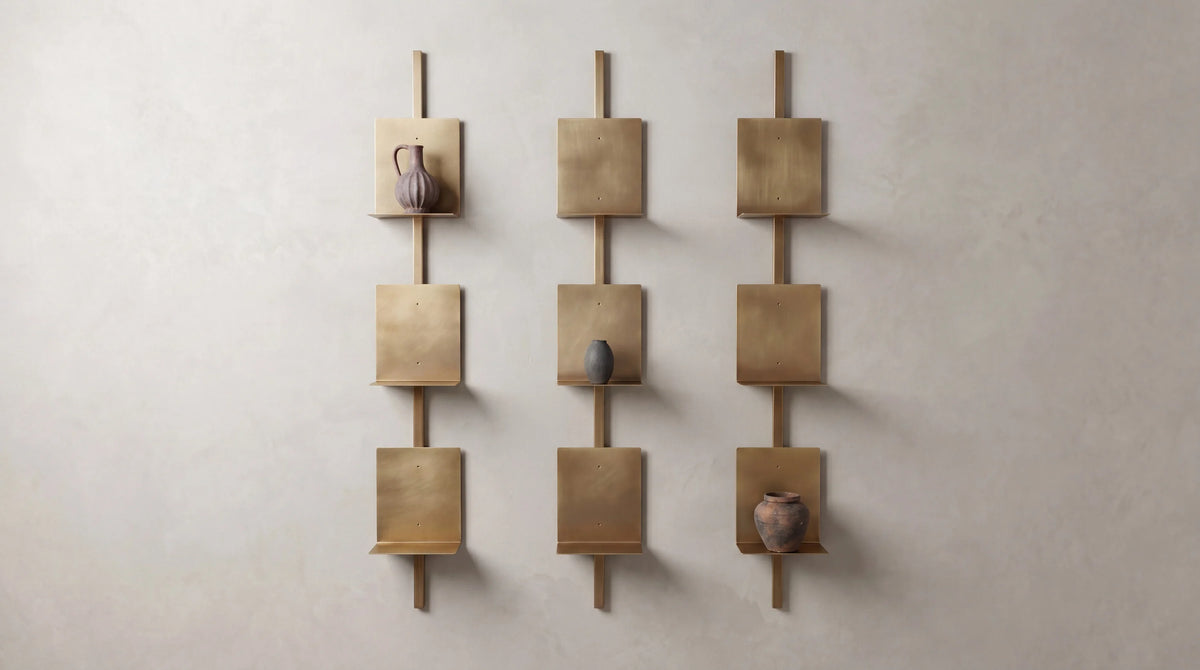
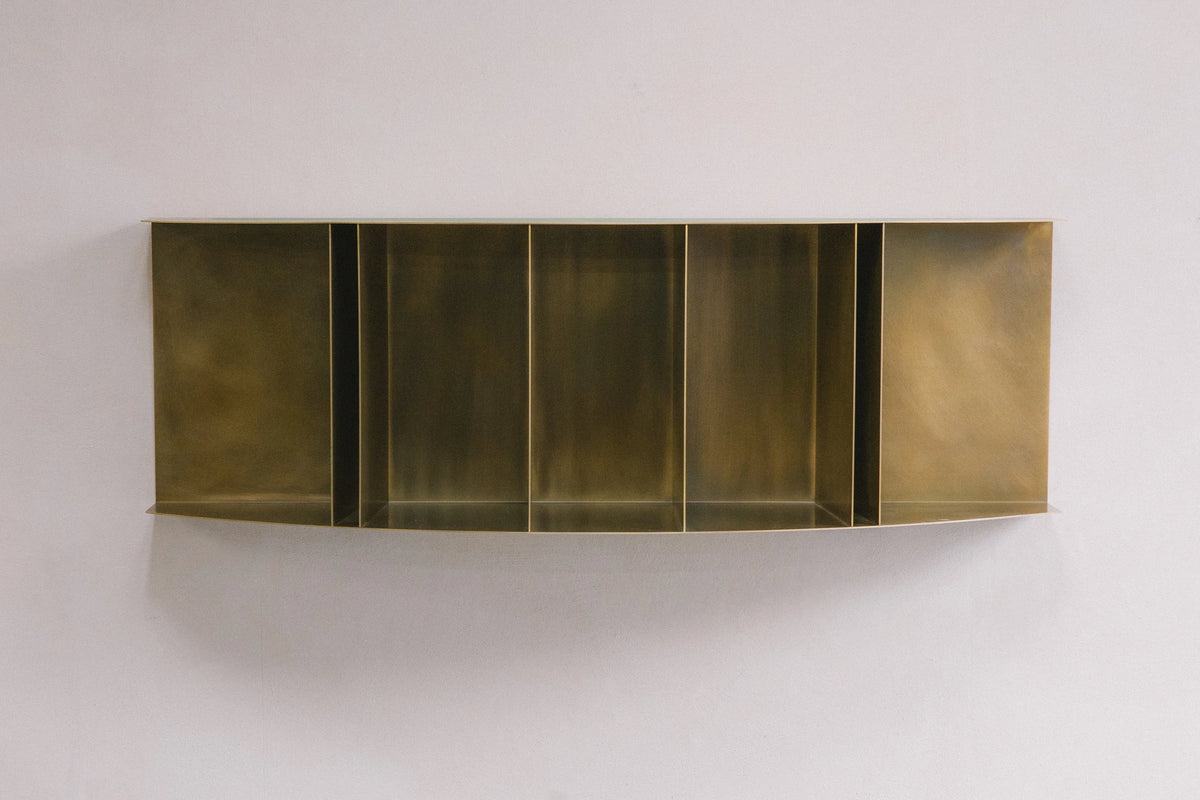
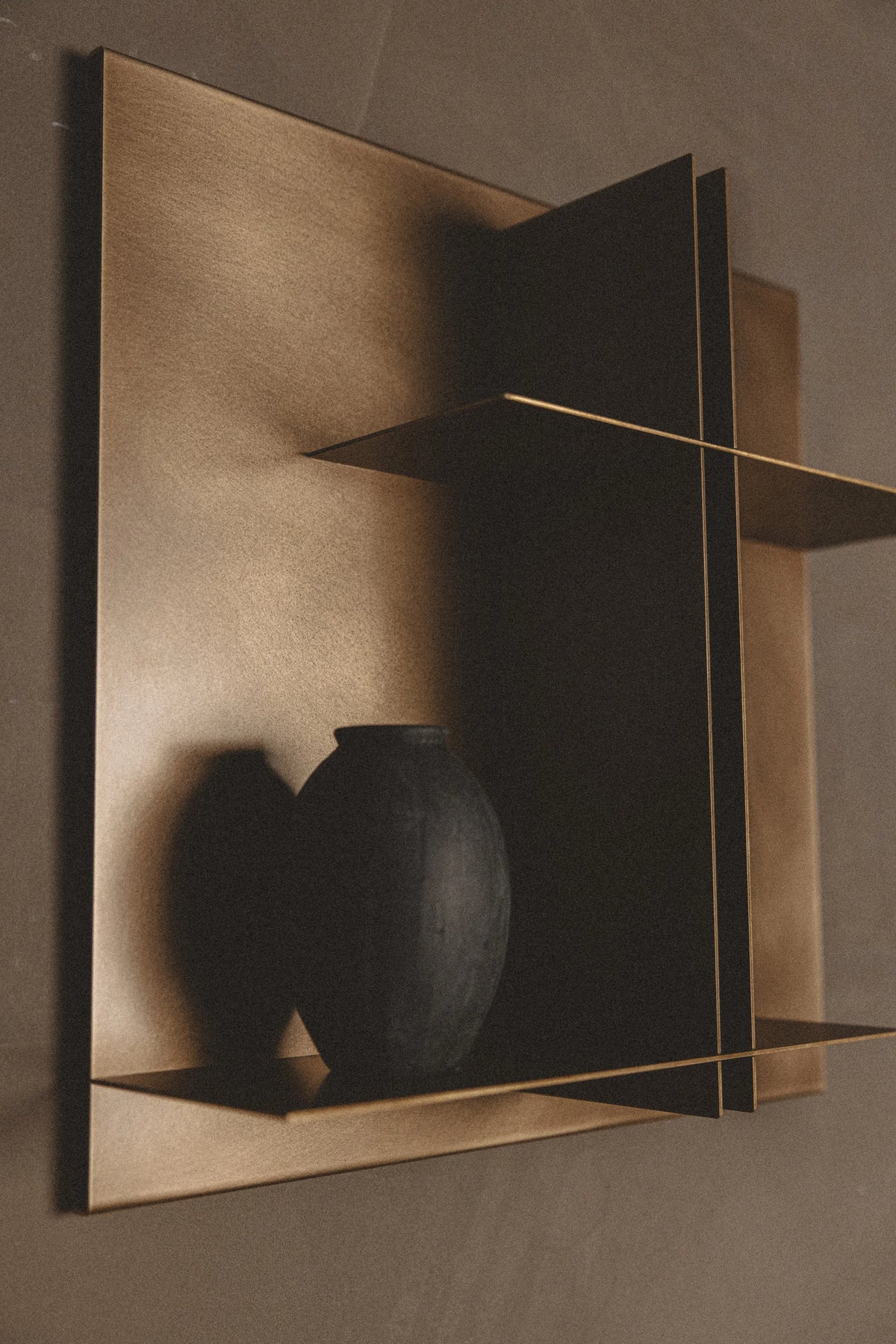
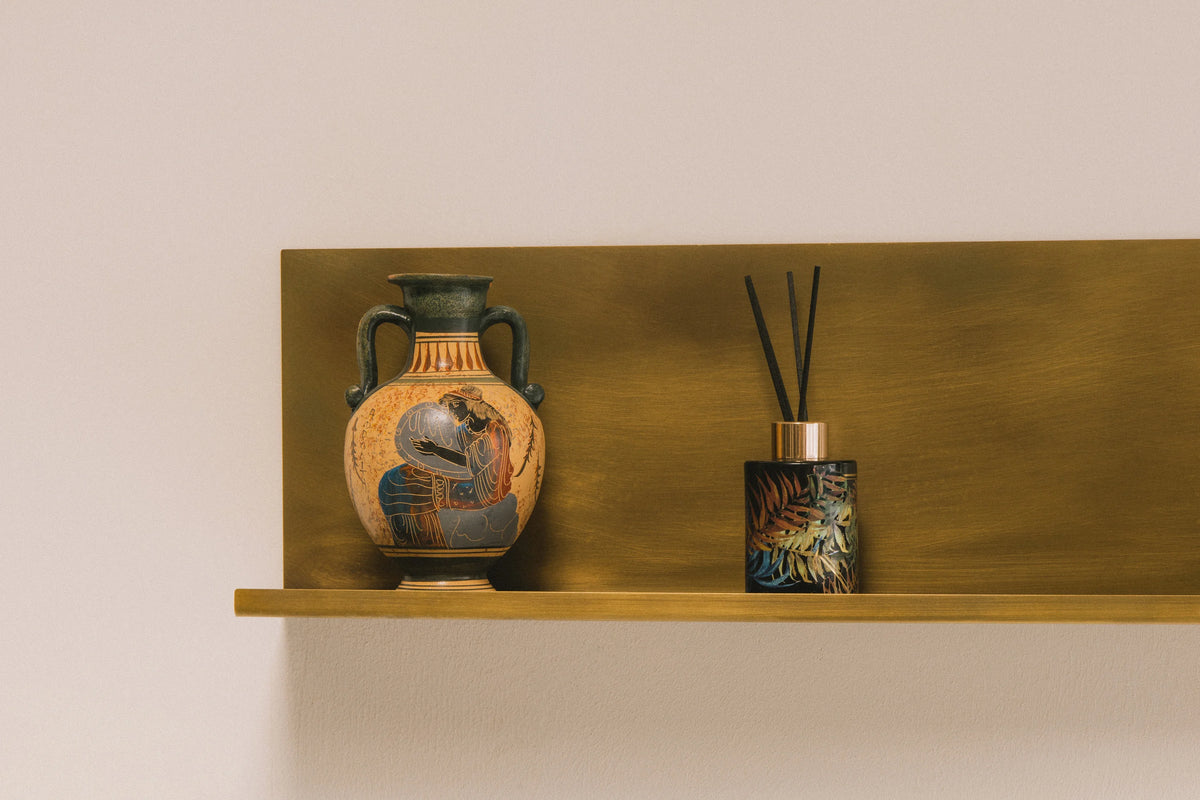
Six wall shelf formats in brass and stainless steel, from a narrow ledge to a modular wall system.
Each piece is made in Germany and is available in standard dimensions as well as made to order on request. Installation and fixing are coordinated to suit the product and the existing wall.
RYU, at 16 cm, is the slimmest shelf in the range, weighs just 4 kg and comes in three lengths from just under 100 to just under 200 cm. Several can be arranged one above the other or offset, turning a single shelf into a continuous wall solution without the need for a frame.
KINKO takes the other route. As a modular wall system, single or as a set of three or five units, it grows across the surface rather than in length. YUGEN combines three offset shelves into a compact group and so sits between the two principles.
JIKU is a sculptural one-off in folded sheet metal; ORIGAMI is made from a single folded metal sheet. CHOWA, at 30 kg, is the heaviest and deepest piece in the range; it frames books and objects rather than merely carrying them. Three pieces in which form comes before surface.
This means the range covers the whole spectrum, from the almost invisible ledge to the piece that is read as an object in its own right. They are two ends of the same task: something is meant to rest on a wall. Between the wall shelf that disappears and the one that remains visible, there is no difference in quality but a difference in intention. Both routes require the same material thickness; they simply lead to different results.
The two uses make opposing demands, which is rarely noticed because both go by the same word. A wall shelf for books needs length, an even depth and a calm form. There, the book spines create the effect; the shelf's task is to keep out of it.
RYU is built for this, in custom lengths even over two metres. A shelf for objects calls for the opposite: different levels, space in between and a form that says something in itself. That is what YUGEN, JIKU and ORIGAMI are for, all three of which are defined more by their form than by their usable surface.
Anyone who wants to accommodate both on the same wall should separate the functions spatially. Books can line up in a continuous row while individual objects above them get their own space. Or the other way round. What rarely works is mixing them on the same level. Book spines and objects call for different kinds of attention; placed directly next to each other, both lose their effect.
Beyond a certain quantity, the question changes. For larger collections, bookshelves are the more consistent solution, because a freestanding system transfers the load to the floor and relieves the wall. At some point, a growing collection begins to define the character of the piece. What starts as a matter for the wall becomes, with the second row, a question of structure and order.
There is no fixed value for the height, only a reference point. Above a sideboard, leave a gap of around 40 cm to the top of the furniture, so that things can be put down and picked up again without brushing the shelf. On a free wall, take your cue from the seat height in the room.
Where people sit, a shelf may hang lower than in a hallway where people stand. With several shelves above one another, equal spacing looks calmer than a staggered arrangement, and the lowest gap may be more generous than those above it. These are proportions that nobody measures and yet everyone notices.
Custom lengths are not a special case for wall shelves. Walls rarely follow standard dimensions, so a shelf should not have to either. What is needed is the desired length, the depth and the type of wall. From this comes a concrete proposal including a fixing concept. A custom size is only made once the order is placed; standard lengths can sometimes be delivered sooner, and the lead time is stated for each shelf. That the type of wall already plays a role when ordering is unusual, and follows from what is said at the beginning of this page.
A wall shelf made of stainless steel or brass is itself the strongest part of the connection. Whether it holds depends on the wall behind it: how it is built and the fixing that suits it. The load does not only act downwards. The deeper a shelf, the harder it pulls on the upper fixing point.
Concrete carries it without difficulty, and solid brick does too when mounted properly. Perforated brick, aerated concrete and plasterboard stud walls need their own fixings. Which of these suits the wall is agreed with the workshop as soon as the wall type and the planned load are clear.
RYU starts at 16 cm and is the slimmest shelf. A precise depth of 20 cm can be made on request, and bespoke depths are common in this category. CHOWA sits around the 30 cm range.
Yes. RYU is designed for this and comes in three lengths that can be combined in a line or staggered. A consistent alignment is important because even small offsets are visible along straight metal edges.
Brushed stainless steel is suitable for interior areas exposed to moisture. Burnished brass reacts more strongly to permanent humidity and steam, so its surface changes faster than in a living room. Stainless steel is therefore the preferred finish for these rooms.
Three aspects matter: material thickness that works without a back panel or cross brace, the quality of the edges, and whether the model can still be reordered in five years. Appearance alone is the easiest characteristic to imitate.
It depends less on the shelf than on the wall. The same construction holds considerably more in concrete than a plasterboard wall can take. That is why there is no blanket figure in kilograms. The right fixing can be determined from the wall type and the planned load.
In concrete, every piece in the range is suitable, including CHOWA, which at 30 kg is the heaviest and deepest. The same applies to solid brick when mounted properly. On stud walls and in aerated concrete, a slim shelf such as RYU, 16 cm deep and 4 kg, is the better choice because it puts the least strain on the wall. Heavier loads there belong in a freestanding shelf.
Yes, every wall shelf comes with wall plugs and screws. Perforated brick, aerated concrete or plasterboard need a fixing that suits the wall; which one is agreed with the workshop.