





Furnishing a study: a room, not a storeroom with a laptop
Where the desk stands, where the light comes from and where things are kept: how a room with a laptop becomes a room for working, on its own or shared with guests, living or sleeping.

In brief
- A study begins with the position of the desk: side-on to the window, with the door in view and your gaze directed into the room rather than at the wall.
- Placed freestanding, the desk becomes an object that brings order to the room; the wall behind the chair becomes a view, in the room as on a video call.
- Only what you want to show stays open; papers, devices and cables get drawers.
- For the study, licht.de cites a basic brightness of 300 to 500 lux, at least 500 lux for a home office used professionally, plus an adjustable, swivelling task lamp.
- If the study shares the room with guests, living or sleeping, each use gets its own side of the room.
Contents
Anyone wanting to furnish a study often starts with what is left over: the room nobody else needs, a table that happened to be free, a chair from the kitchen. The result is a place where you work because that is where the laptop lies, and not because the room invites you to. Yet there is hardly a room in which you spend so many waking hours at a stretch, thinking, writing, making calls. The room shapes these hours more than any device on the table.
This article orders the study from its position: where the desk stands, where the light comes from, where things are kept and how the room becomes homely. At the end, it turns to rooms that have more than one task, from the guest room to the bedroom. Anyone who prefers to think of the desk as a workbench will find that reading in the article Industrial-style office.
Furnishing a study: first, the spot by the window
Before a single piece of furniture is chosen, it is worth looking at the floor plan. Where does daylight come in, where is the door, where do the paths through the room run? From these three answers comes the position of the desk, and with it the order of everything else. Anyone wanting to design a study therefore plans from the table, not from the shelf.
- Light: window to the side
- View: into the room, not at the wall
- Door: in the corner of your eye
- Path: clear to the window
For screen work, the German Social Accident Insurance (DGUV) recommends positioning the workstation so that your line of sight runs parallel to the window front [2]. Daylight then falls on the top from the side and does not dazzle. If you sit with your back to the window, the bright opening is reflected in the screen; if you sit facing the window, the dark monitor stands in front of a bright sky.
A second thought concerns the door. If you sit with your back to it, you turn around at every sound. With the door in the corner of your eye, you work more calmly, and the room opens up in front of you rather than behind you. Many modern ideas for a study begin at exactly this point: with a table that is not pushed against the wall but faces into the room.
Designing a study also means planning distances. Behind the chair, you need space to roll back and stand up, and between table and shelf a path you can walk in a straight line. Marking the area of the table on the floor before deciding shows immediately how much space remains all around.
The desk as the centre of the room
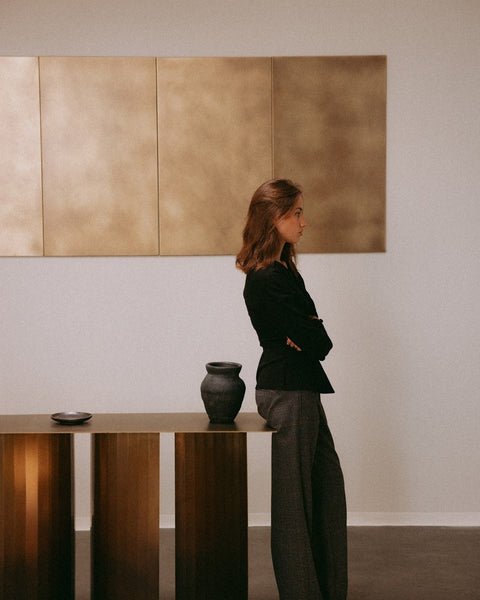
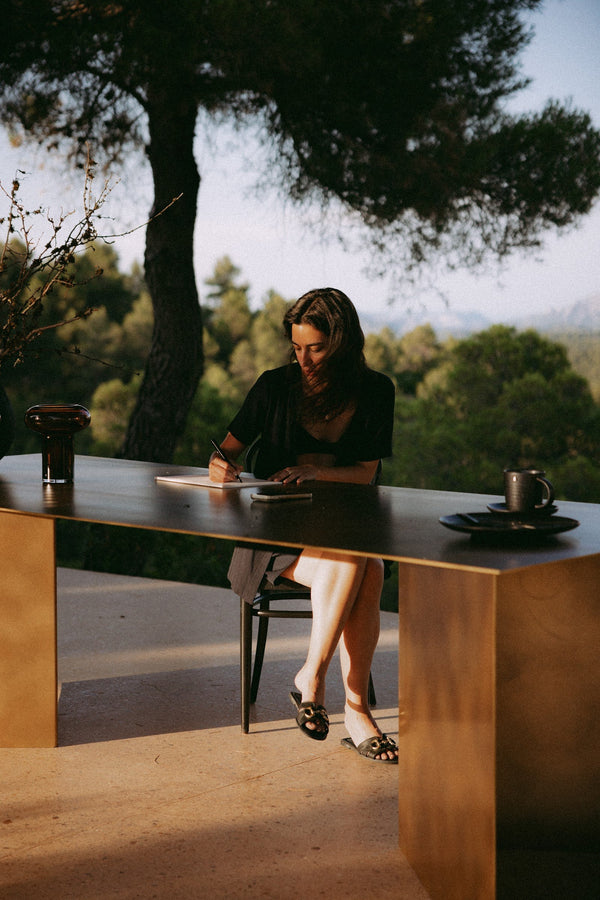
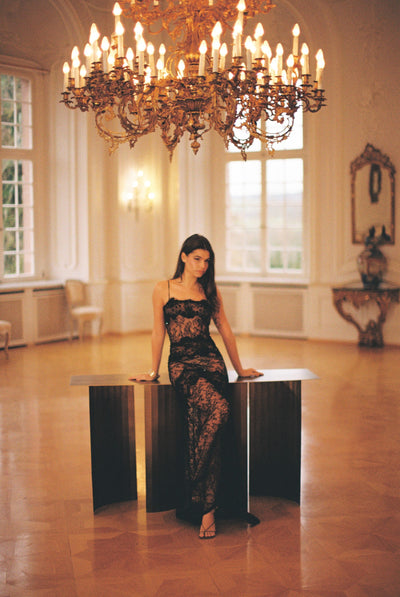
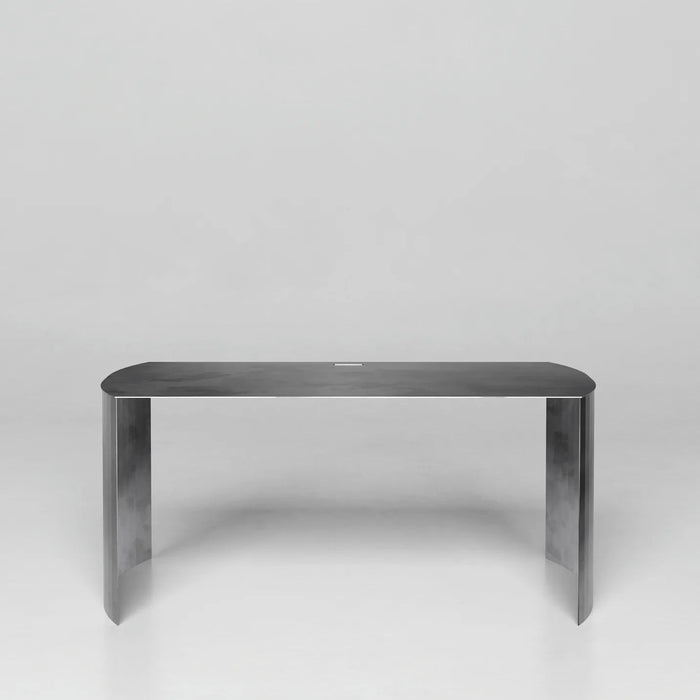
When furnishing a study, choose the desk first and everything else afterwards. A desk against the wall is a workplace. A desk standing freely in the room turns the room into a study. The difference lies in how much of it you see. Against the wall, it shows only its edge; placed freely, it shows its legs, its top and the space beneath, and it becomes an object around which the room is ordered.
- Position: freestanding or at right angles to the wall
- Visible: legs, top, space beneath
- Material: brushed stainless steel, 2K clear lacquer
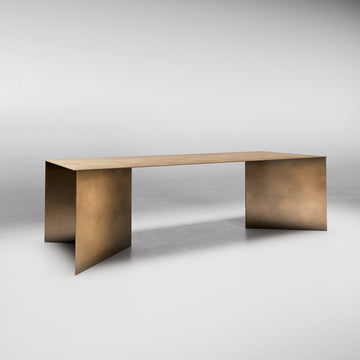
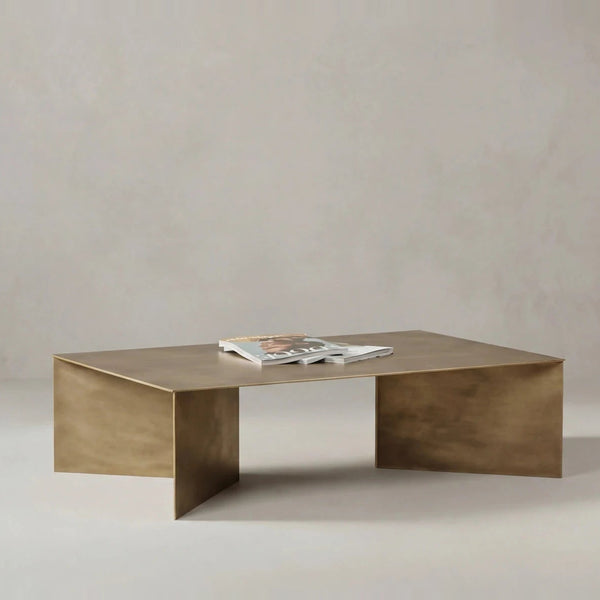
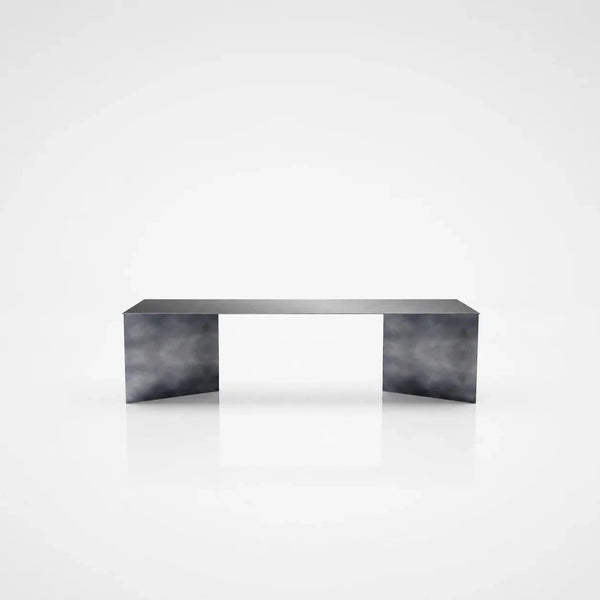
OYAKATA is made for this position. Its legs of solid stainless steel are quilted, a rhythmic structure that only reveals its full depth at second glance [1]. The top above remains completely open, without superstructure and without a modesty panel. The table is made of brushed stainless steel and sealed with 2K clear lacquer; the product page gives its dimensions as 160 × 79.9 × 80 cm or 181 × 79.9 × 80 cm [1].
Such a table asks for little around it: a chair that suits it, a lamp, a bowl for pens. Ideas for a modern study therefore lie less in additional furniture than in the surface you leave free. The empty top is the clearest sign that focused work happens here. Cables run along one table leg to the floor, so that the view from the door stays calm.
Order you can show
Setting up an office at home means above all finding a place for things: documents, books, chargers, Monday's post. A room in which all of this lies in the open feels restless. A room in which everything disappears behind cupboard doors feels like an archive. For the order of a furnished study, a simple rule therefore applies: only what you want to show stays open, everything else gets a drawer.
- Open: books, objects, a picture
- Hidden: papers, devices, cables
- Wall: shelves instead of a wall unit
- Drawers: next to the table
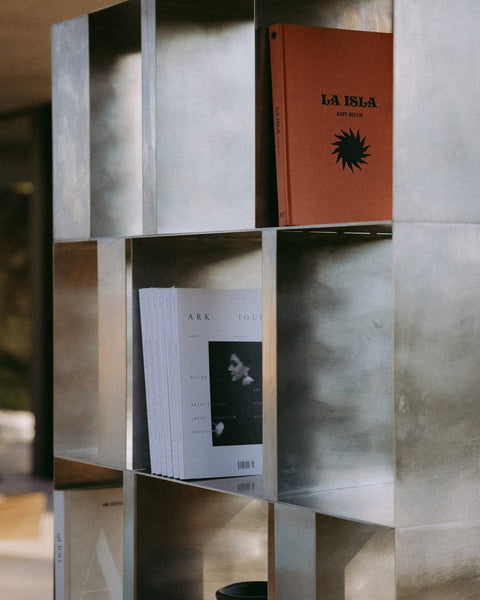
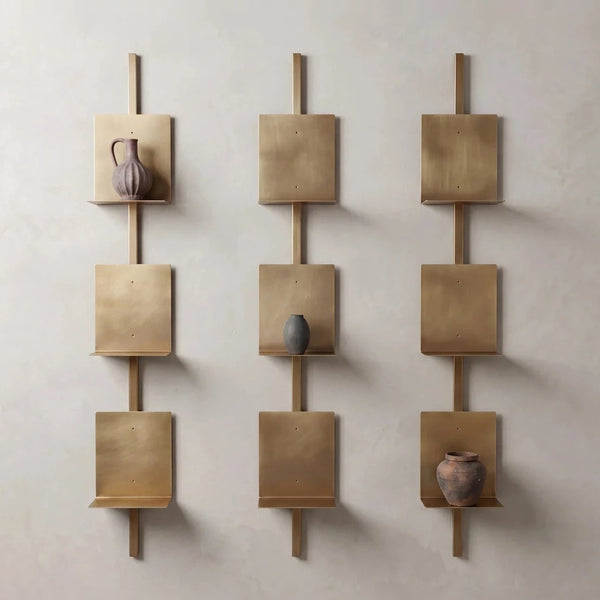
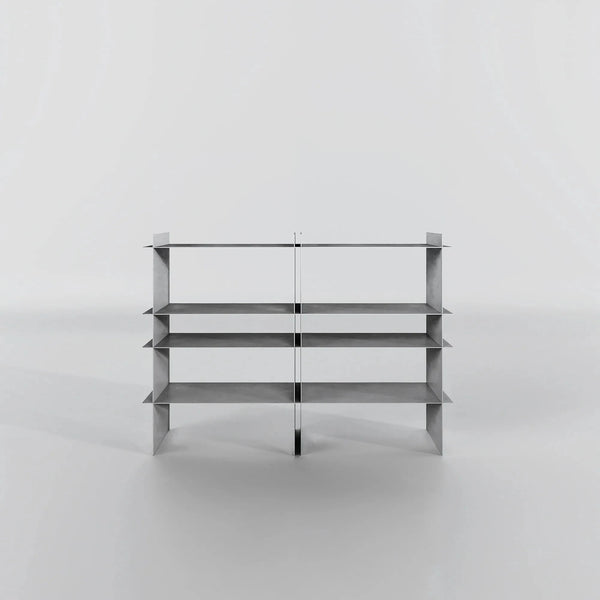
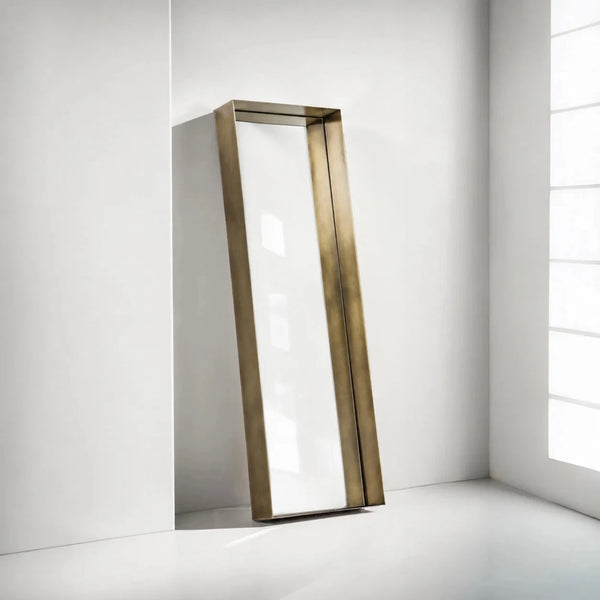
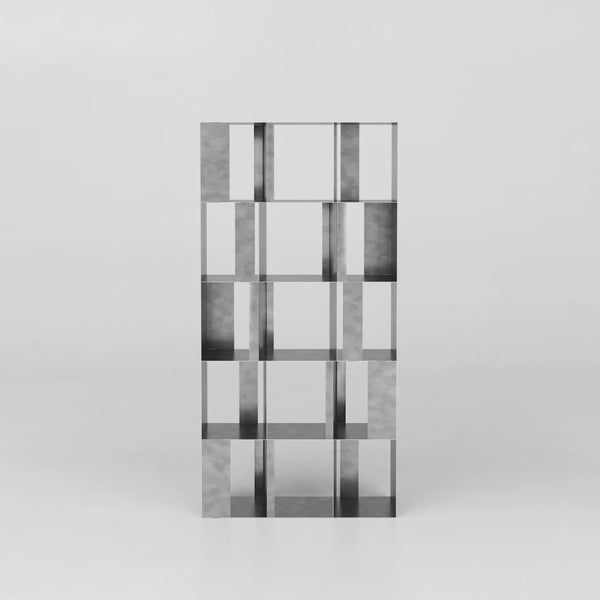
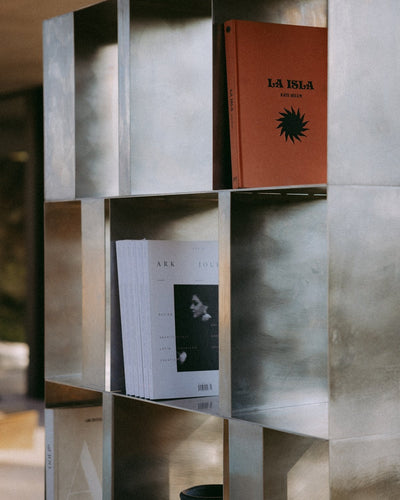
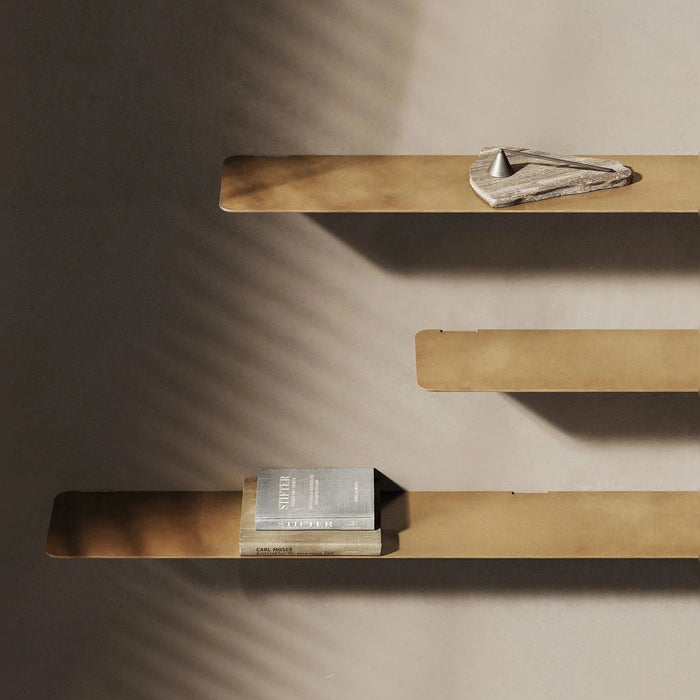
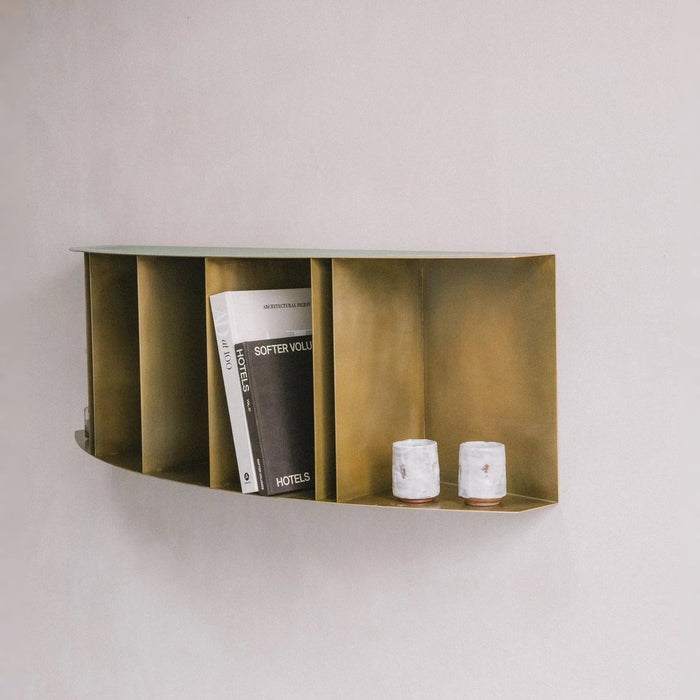
For what you show, a few shelves are enough. RYU is a slim wall shelf in three lengths, 16 cm deep, in burnished brass or brushed stainless steel [1]. Above the desk, it holds a row of books without crowding your head. CHOWA opens in a crescent-like form and frames what stands in it [1]; on the wall next to the table, it becomes a picture of two books and a piece of ceramics.
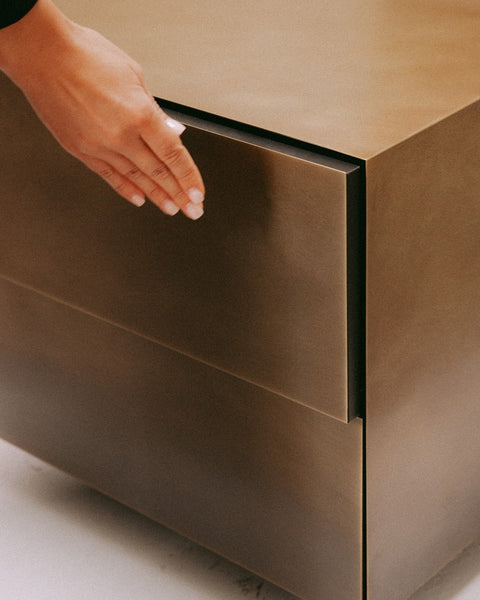
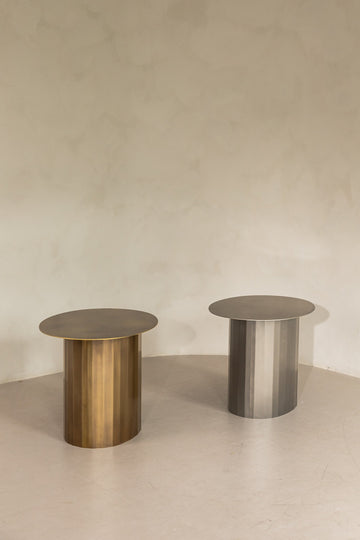
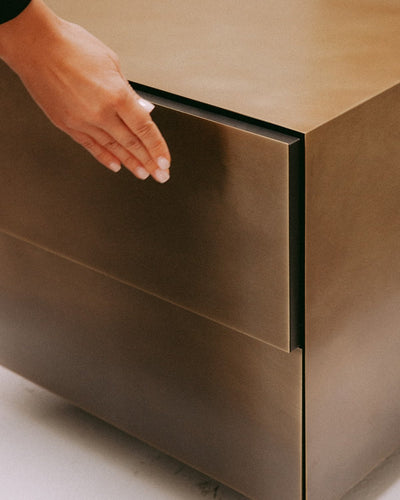
For everything else, you need drawers, and they do not have to look like office furniture. The chest of drawers YORU is clad in brass, has two handleless drawers, measures 45 × 55 × 50 cm and is sealed with 1K clear lacquer [1]. Next to the desk, it takes in papers and devices. Across its front runs a transition from light to dark that the workshop deliberately guides during burnishing; the sealing preserves it.
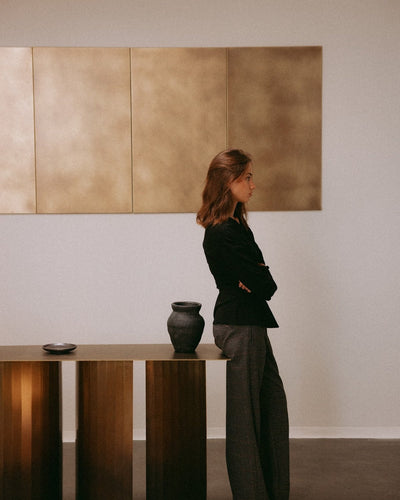
The wall behind the chair deserves particular attention. In the room, it is the back of the workplace; in every video conference, the background. A shelf with a few books, a picture, a calm surface: it needs no more for the room to look like a room even on someone else's screen.
Mentioned in this article
Pieces from this article.

Light in the study: three levels
When furnishing a study, the light is often considered last, yet it largely decides how long you enjoy sitting there. The industry initiative licht.de distinguishes three levels: general lighting, task lighting and accent lighting [3]. The general lighting should create a basic brightness of between 300 and 500 lux. If the home office is used professionally, at least 500 lux and a colour rendering of at least Ra 80 apply [3].
- Basic light: 300 to 500 lux
- Professional use: at least 500 lux, Ra ≥ 80
- At the table: adjustable, swivelling lamp
- Accent: shelf and wall
The desk itself needs a lamp that can be adjusted and swivelled. Floor, wall and pendant lamps should emit their light well above the head height of a seated person so that they do not dazzle, and no lamp in the room should be reflected in the screen [3]. Indirect light for the room and direct light for the top complement each other; licht.de recommends combining the two [3].
The third level turns the workplace into a room. An illuminated picture, light above a shelf, a glow on the wall behind the chair: according to licht.de, accent light creates a pleasant atmosphere [3]. On brushed stainless steel, such light spreads softly across the cloudy grain; on burnished brass, it becomes a warm shimmer. For the evening, licht.de describes warm white light as particularly pleasant, whereas cooler light colours can be activating in the morning [3].
A cosy study
Making an office cosy sounds like a contradiction, but it is a question of surfaces. Anyone wanting to make their study cosy therefore starts with the floor and the window, not with decoration. Concentration needs calm, and calm arises where the eye finds nothing glaring. A rug under the desk muffles footsteps and chair castors, a linen curtain softens the light from the window, and an armchair in the corner gives the room a second place where you read instead of write.
- Floor: rug under the table
- Window: linen
- Second place: armchair for reading
- Wall: muted and warm
The wall colour may be muted: a warm grey, a light sand, a toned-down green. Strong tones belong on the wall behind you rather than on the wall you look at. Books, plants and a picture that has nothing to do with work give the study a personal side without burdening the work surface. Good ideas for a study are often the smallest here: a postcard on the shelf, a stone from the beach, a pot for tea.
Metal does not stand in the way of this homeliness; it gives it something to hold on to. Placed alongside wool and linen, brushed stainless steel looks clear and quiet, burnished brass dark and warm. Which of the two metals suits a room better depends on its light and on the hours during which it is used; the article Brass or stainless steel explores this question.
A study combined with a guest room, living room or bedroom
Many studies are guest rooms at the same time, and furnishing a study with a guest bed is a common task. It works when each use gets its own side of the room: the desk by the window, the sofa bed or guest bed against the opposite wall. For nights with visitors, you need a surface next to the bed and a free drawer. YORU was originally conceived as a bedside table [1] and takes on this role as soon as the documents move into a drawer for a few days.
- Guest room: table by the window, bed opposite
- Living room: table freestanding, shelf behind
- Bedroom: table out of sight from the bed
Setting up a home office in the living room calls for more restraint. There, the desk stands in a room that belongs to other things in the evening, and it must therefore convince as a piece of furniture. A freestanding table with a shelf behind it forms its own zone without dividing the room. How to form such areas in a large room is shown in the article Furnishing a large living room.
In the bedroom, the opposite rule applies: here the workplace should disappear as soon as the light goes out. Ideally, the desk stands where it is not in view from the bed, for example on the wall next to the door. An empty top and a drawer for the devices ensure that nothing of the working day can be seen any more when the room serves for sleeping again. For all three cases, the same applies as for a study of its own: ideas that manage with fewer things go further than any additional surface.
In the morning, the light falls on the top from the left, the task lamp is still off, and on the shelf stand the three books that are needed right now. In the evening, the same table lies in the glow of a floor lamp, the top is empty, the drawer closed, and the room is a room again.
Frequently asked questions
What matters when furnishing a study?
The position of the desk, the light and the storage space. The table is best placed side-on to the window, so that your gaze runs parallel to the window front, with the door within your field of vision. Then come the task lamp and general lighting, followed by storage: open shelves for books and objects, drawers for papers and devices. A rug and curtains make the room calmer.
Where should the desk go in a study?
Side-on to the window, so that daylight comes from the side. For screen workstations, the German Social Accident Insurance (DGUV) recommends a line of sight parallel to the window front to avoid glare. With your back to the window, reflections appear on the screen; facing the window, there is a strong contrast between sky and monitor. A freestanding table that faces into the room also feels more open than one against the wall.
How brightly should a study be lit?
For the general lighting in a study, licht.de cites 300 to 500 lux. For a home office used professionally, at least 500 lux and a colour rendering of at least Ra 80 apply. At the desk, an adjustable, swivelling lamp is added. All lights should be aligned so that they do not dazzle and create no reflections on the screen.
Which materials and colours make a study cosy?
With soft surfaces and warm light: a rug under the desk, curtains of linen or wool, an armchair as a second place for reading and muted wall colours such as warm grey or sand. Warm white light is perceived as particularly pleasant in the evening. Books, plants and a personal picture give the room character, as long as the work surface stays clear.
Can a study and a guest room be combined?
Yes, if both uses get their own side of the room: the desk by the window, the guest bed or sofa bed against the opposite wall. A chest of drawers serves as storage at the desk in everyday life and as a surface next to the bed when visitors come. What matters is that documents can be put away quickly and completely.
Where can a home office fit into a bedroom?
In a spot that is not in view from the bed, such as on the wall next to the door or behind a shelf. A top without superstructures and a drawer for laptop and cables help to take the workplace out of sight in the evening. The task lamp should be switchable separately from the other lights.
What should you bear in mind with a stainless steel desk?
Brushed stainless steel copes well with pens, cups and devices; ZinCuTec makes its furniture from stainless steel 1.4404 (V4A). OYAKATA is additionally sealed with 2K clear lacquer. Fingerprints do not stick to the sealing. Clean it with a soft cloth, such as microfibre, and alcohol-free glass cleaner or a little soapy water; polish and abrasive cleaners do not belong on it. For office chairs with castors, a rug or a floor protection mat under the table is advisable.
Sources & references
- [1]ZinCuTec GmbH: Produktangaben OYAKATA, RYU, CHOWA und YORU (Maße, Material, Oberfläche, Versiegelung, Pflegehinweise), zincutec.eu, abgerufen am 12.10.2026
- [2]Deutsche Gesetzliche Unfallversicherung (DGUV): Tipps gegen Hitze und blendende Sonne im Büro, Pressemitteilung vom 02.06.2022, abgerufen am 12.10.2026 dguv.de/de/mediencenter/pm/pressemitteilung_492800.jsp
- [3]licht.de (Brancheninitiative für Beleuchtung): Arbeitszimmer, Lichtanwendungen Wohnen, abgerufen am 12.10.2026 licht.de/de/lichtanwendungen/bereich/5-wohnen/16-arbeitszimmer
How we work: journal articles are written in the workshop, checked by a specialist before publication and updated when something changes. Editorial principles
Read on
You might also like.

Setting a festive Christmas table: brass instead of gold, calm instead of abundance
A Christmas table feels festive when the tabletop stays visible and a few things are given weight. How place settings, centrepiece, colour and candlelight come together without overloading the table.Read article
Setting the table: the rules of the place setting and why the tabletop has a say
Where cutlery, glasses, napkin and bread plate go follows a simple logic. How it can be applied on a metal table and what the tabletop itself dictates.Read article