






Zen interiors in metal: the ZEN series in five details
Anatomy of a design: how a folded sheet, a concealed support and a solid edge translate the calm of the Zen style into four pieces of furniture.

In brief
- Zen interior design means few things, calm surfaces and furniture that gets by with a single idea.
- The ZEN series translates this attitude into metal: every piece stands on two supports; in almost all pieces they are formed from a single sheet folded to an angle.
- A concealed support, a solid tabletop edge and a matte, sealed surface keep the form calm.
- The same fold appears in four scales: as a coffee table, dining table, console and bench, in brushed stainless steel and in burnished brass.
Contents
Zen interior design begins with a question that leaves out more than it adds: what does a room need in order to become still? The ZEN series by ZinCuTec puts this question to four pieces of metal furniture: a coffee table, a dining table, a console and a bench. This article breaks the series down into five details, from the folded leg to the surface, and shows what each of them contributes to the calm of the Zen style.
The details are small, and some only become apparent at a second glance. Together they explain why four very different pieces of furniture are read as one family.
Zen interior design: what the style asks of a piece of furniture
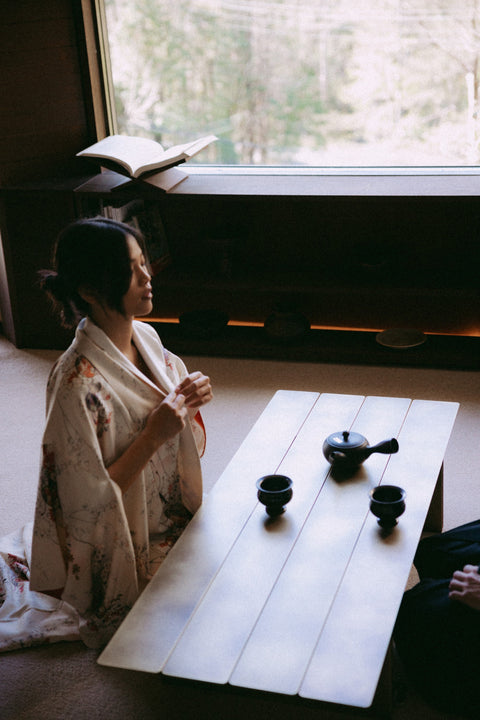
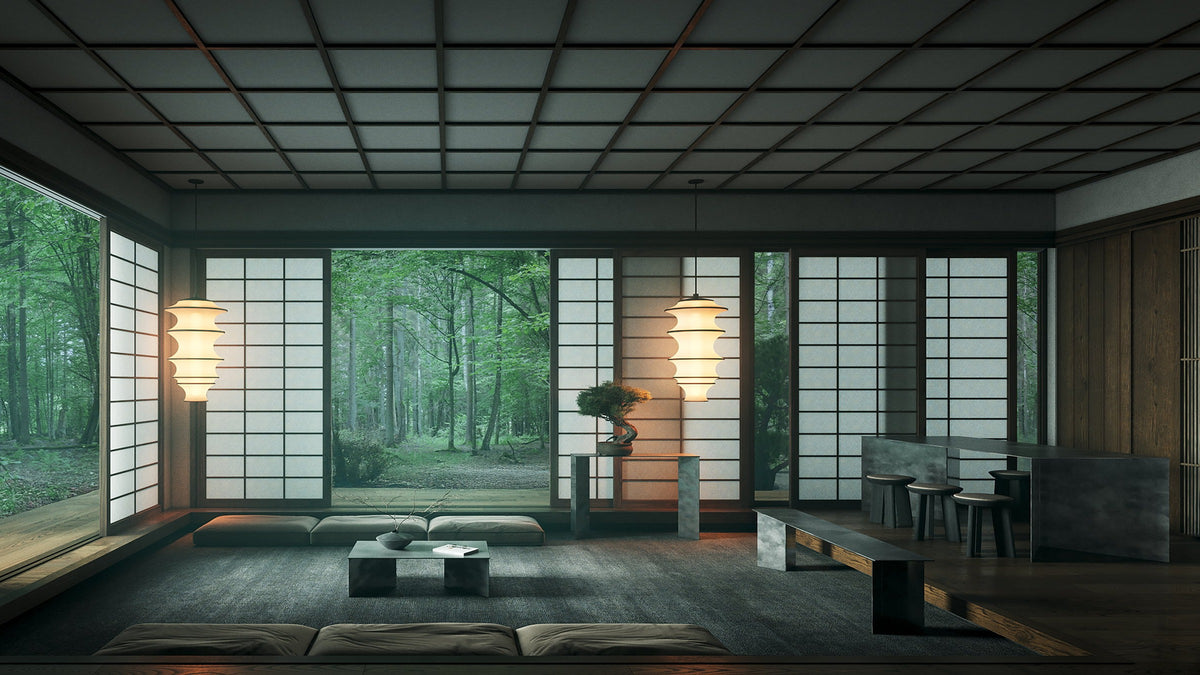
Zen is a school of East Asian Buddhism; in China it is called Chan, in Korea Sŏn [2]. In interiors, the term has largely detached itself from this origin. Today a room in the Zen style stands above all for an attitude: few things, calm surfaces, muted colours and materials whose nature you can see.
- Origin: a school of East Asian Buddhism
- In the room: few things, calm surfaces
- Furniture: one idea, no ornament
- Metal: matte, brushed or burnished
Zen interior design therefore asks every piece of furniture to get by with a single idea. Ornaments, handles, visible screws or a second material distract. What remains is the construction itself, and it has to be resolved in such a way that it can be shown.
At first, metal seems to have little to do with the Zen style, which is usually described in terms of paper, stone and pale fibres. With a matte surface and a concise form, however, it fits in quietly. Where metal has its place among the familiar interior styles is described in the article Interior styles at a glance. Here the question is a narrower one: how a single series translates this idea into sheet metal.
Detail 1: the fold that replaces a leg
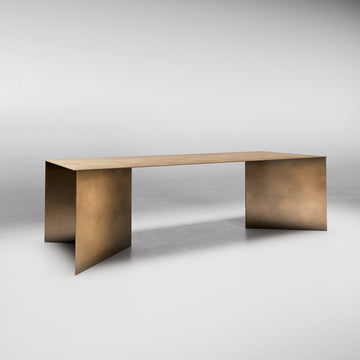
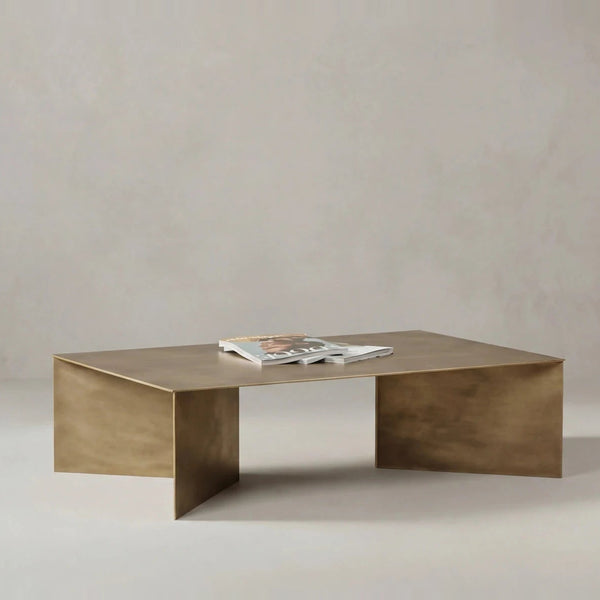
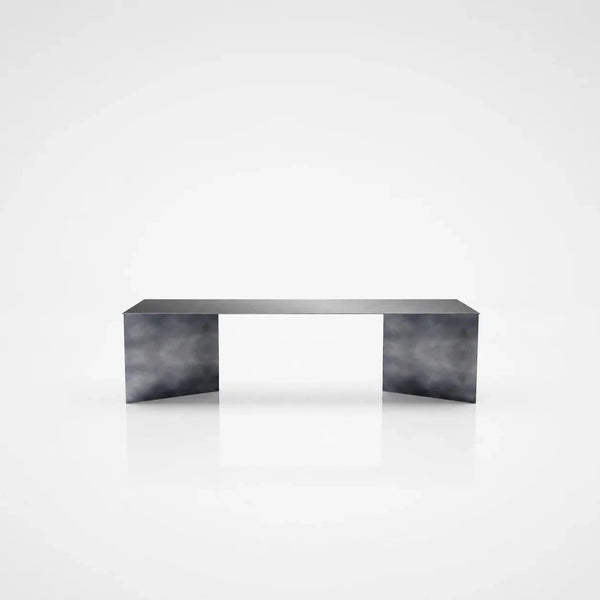
Every piece in the ZEN series stands on two supports; in almost all of them they are made of folded sheet metal [1]. In the workshop, a single sheet is folded to an angle and gains its rigidity from this. Such a leg needs no tube, strut or crossbar.
- Component: one sheet, folded to an angle
- Rigidity: from the form, not from mass
- Supports: two per piece
- Front view: a narrow line
For the Zen style, this solution is more than engineering. The fold is the only gesture the furniture makes, and it is not hidden. From the front the leg shows only a narrow line, from the side its full angle. Walking around the table, you see the form open up and close again.
The Japanese art of paper folding turns a flat sheet into a body with just a few creases. The ZEN series takes up this image without imitating it: a flat material becomes load-bearing through a single fold, and no further effort is visible.
Detail 2: a connection you cannot see
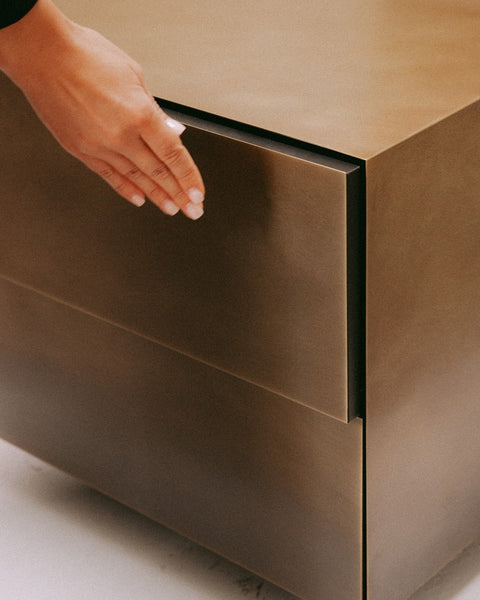
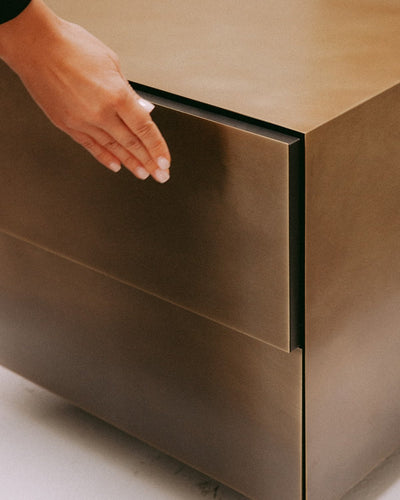
Where top and frame meet, many pieces of furniture show their screws. Beneath the tops of the ZEN DINING TABLE, ZEN CONSOLE and ZEN BENCH, by contrast, there is a stainless steel support that is screwed on from below [1]. From above and from the side, the connection remains invisible.
- Location: beneath the top
- Solution: stainless steel support, screwed on from below
- Effect: no visible screw
- Principle: only the form stays in view
For a Zen interior, this restraint is valuable. A piece of furniture that does not show off its fixings leaves the eye with nothing but the form: top, edge, support. Nothing distracts from the one idea that carries the piece.
This calm is most evident up close. Lean over the table and you will find no screw and no fitting, only metal and edge.
In the room, the gap reveals itself above all in the light. When light falls from the side, a fine bright line appears between the edges; in lamplight in the evening, a narrow shadow. In this way the furniture acquires a small drawing at every time of day without bearing a single ornament.
Detail 3: the solid edge of the top
The tops of the ZEN series do not end in a folded rim but in a solid edge [1]. Looking at the table from the side, you therefore see not a thin sheet metal edge but a closed surface of even thickness.
- Form: solid edge
- View: a closed surface instead of a sheet metal edge
- Effect: calm proportions
- Relation: counterpart to the folded support
The edge gives the furniture its proportions. It makes the top appear calm and assured, yet remains flat enough not to look heavy in the Zen style.
Solid edge and folded support complement each other: one shows the material, the other a movement. Together they make the series look all of a piece, even though top and supports are separate components.
Detail 4: a surface without noise
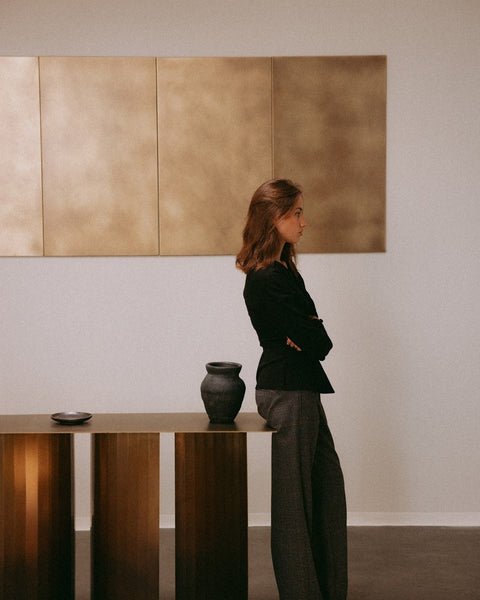
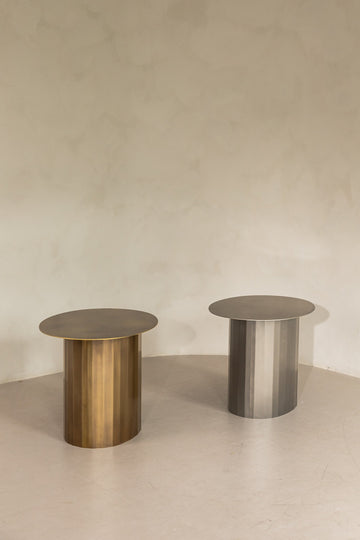
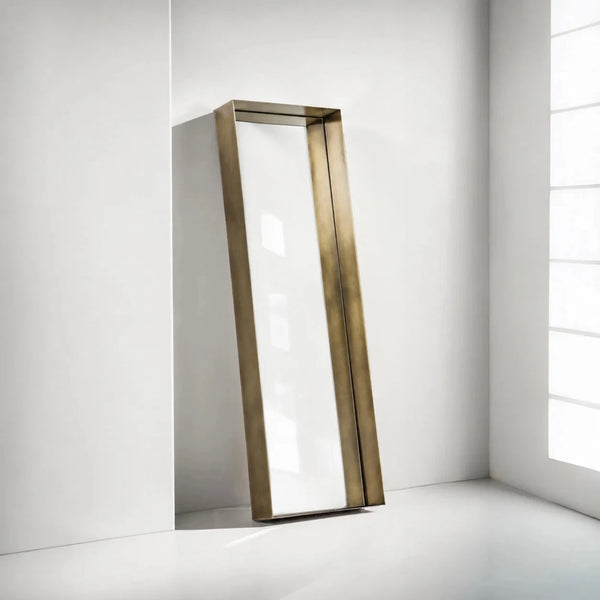
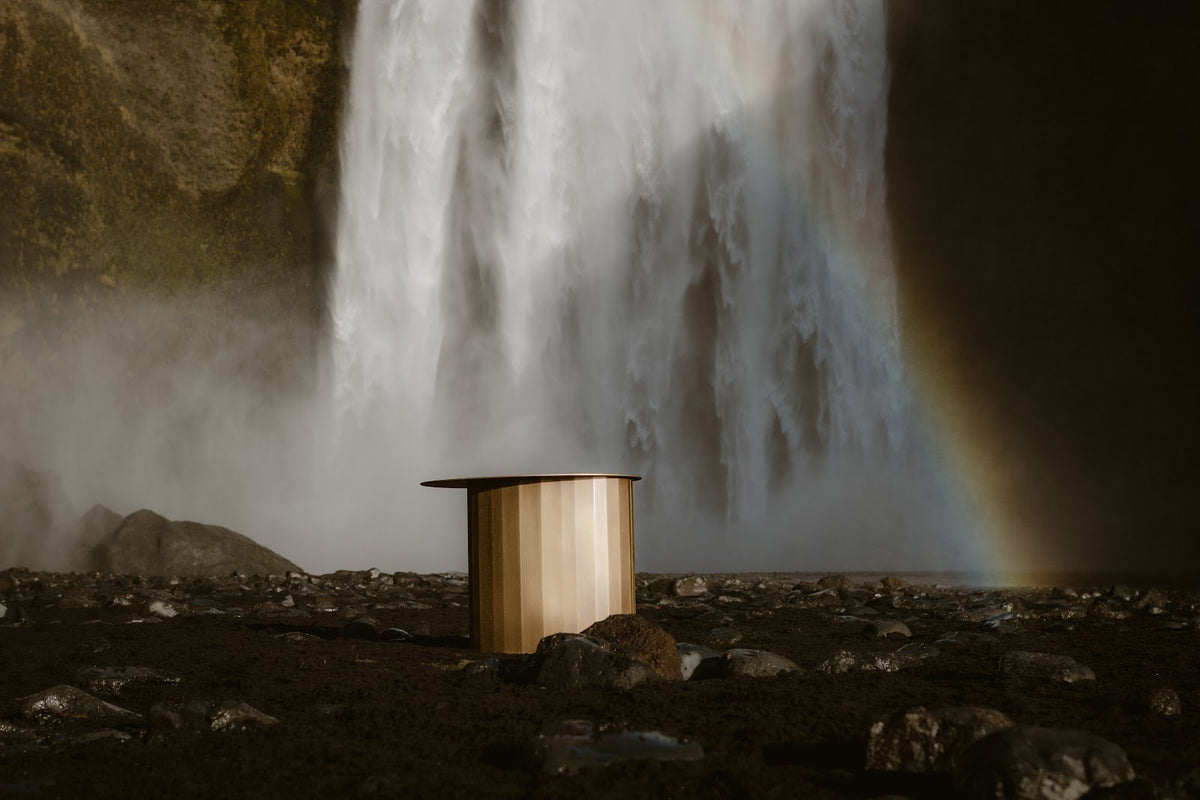
A Zen room has no place for a mirror shine. All four pieces of the ZEN series are therefore available in brushed stainless steel and in burnished brass [1]. The cloudy grain of the stainless steel absorbs the light instead of reflecting it back.
- Stainless steel: brushed, material 1.4404
- Brass: burnished, material CuZn37
- Protection: sealed, the tables with 2K clear lacquer
- In both metals: all four pieces
Burnished brass gives the series depth. The burnishing is carried out in the workshop in several steps and gives the metal a warm, dark tone; bare brass would not have this calm. The subsequent sealing preserves the tone exactly as it leaves the workshop [1].
ZinCuTec uses stainless steel 1.4404 and brass CuZn37 as its materials [1]. All pieces in the series are sealed, and they need little in the way of care. What to bear in mind is explained on the Care page.
Detail 5: four scales, one principle
The fifth detail is scale. The same design language appears at four heights: in front of the sofa, at the dining table, against the wall and as a bench. The ZEN COFFEE TABLE measures 100 × 63 cm at a height of 27.5 cm and weighs 30 kg [1]. In a Zen living room it sits below seat height and lets the eye travel across the room.
- Coffee table: ZEN COFFEE TABLE, 100 × 63 × 27.5 cm
- Dining table: ZEN DINING TABLE, 200, 250 or 300 × 100 × 75 cm
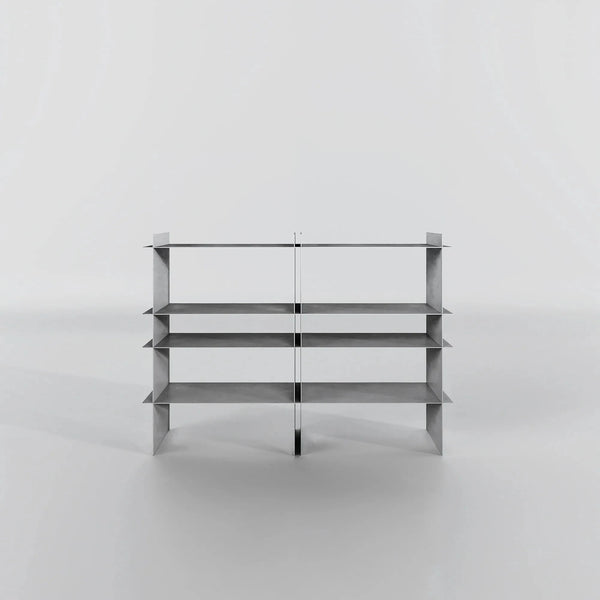
- Console: ZEN CONSOLE, 120 × 32 × 80 cm
- Bench: ZEN BENCH, 200 × 35 × 45 cm
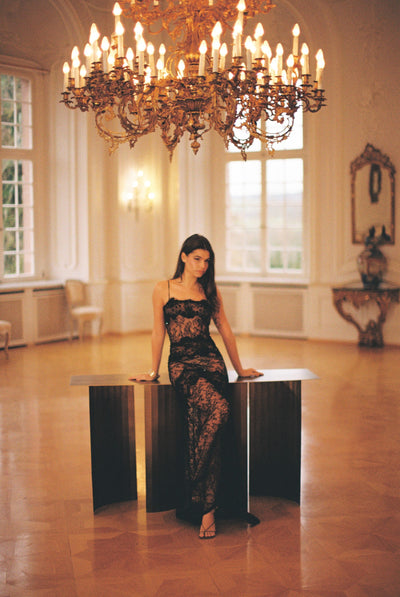
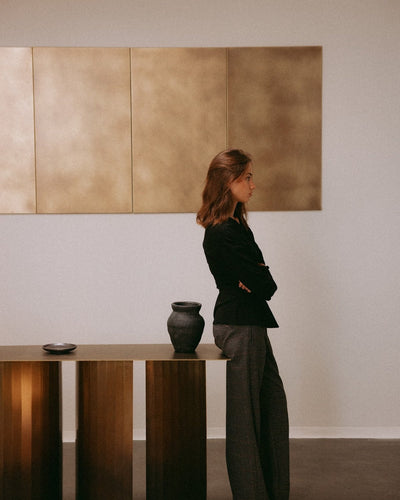
The ZEN DINING TABLE brings the fold to the dining area in lengths of 200, 250 and 300 cm, always 100 cm deep and 75 cm high; there, two folded legs hold a solid top [1]. The ZEN BENCH, at 200 × 35 × 45 cm, translates it into a seat resting on two clearly drawn triangles [1]. The ZEN CONSOLE carries the same line to the wall and remains slender there at 32 cm deep [1].
If you want to furnish in the Zen style, you do not need all four. One piece is enough to bring calm to a room; two already create a connection across the threshold, such as the console in the hallway and the coffee table in the living room. The article Furnishing a dining room shows how a dining area takes shape around the table, and the ZEN category brings together all pieces in the series.
The two metals can be mixed within the series. A coffee table in burnished brass in front of the sofa and a bench in brushed stainless steel by the window speak the same design language in two colours. What matters for a Zen interior is less the choice of metal than the number of things standing next to the piece.
In the evening the light falls low across the floor. Beneath the coffee table it traces the two angles, two bright lines on the parquet with a strip of shadow between them. There is no more movement than this in the room, and it needs no more.
Mentioned in this article
Pieces from this article.


Frequently asked questions
What does Zen interior design mean?
The term comes from Zen, a school of East Asian Buddhism. In interiors it stands for a few carefully chosen pieces of furniture, calm surfaces, muted colours and visible materials such as stone, paper, linen or matte metal. Decoration steps back; empty space is part of the design.
What belongs in a Zen-style living room?
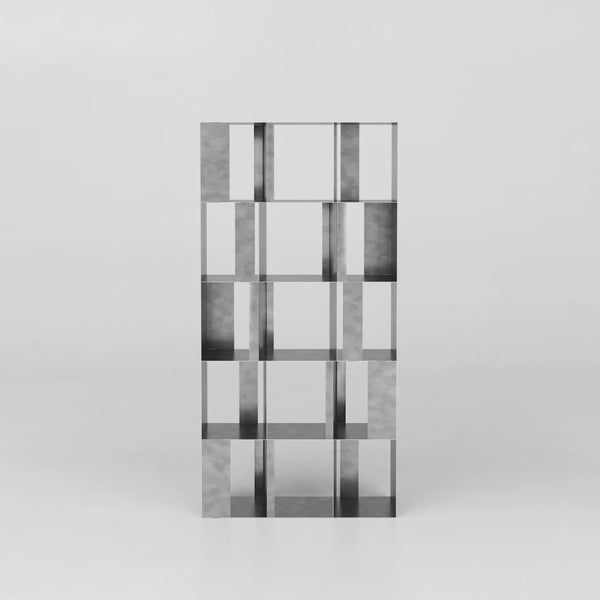
With a few low pieces of furniture, a restrained colour palette and plenty of free wall and floor space. A flat coffee table below seat height keeps the view open, such as the ZEN COFFEE TABLE at 27.5 cm high. Open shelves hold only a few things, and lamps give warm, indirect light.
Which pieces belong to the ZEN series?
Four pieces: the coffee table ZEN COFFEE TABLE, the dining table ZEN DINING TABLE, the console table ZEN CONSOLE and the bench ZEN BENCH. What they share is their design language; almost all of them stand on supports made from a sheet folded to an angle. All four are shown in the ZEN category.
What is the ZEN CONSOLE?
A slender, handmade console table in brushed stainless steel or burnished brass on two folded legs. It is intended for the hallway, the living area or the wall behind a sofa, and it carries the design language of the ZEN series to a height at which you set things down.
Which metals is the ZEN series made from?
All four pieces are available in brushed stainless steel or burnished brass. The materials used are stainless steel 1.4404 and brass CuZn37. All four are sealed, the ZEN COFFEE TABLE and the ZEN DINING TABLE with 2K clear lacquer.
Does the ZEN BENCH go with the ZEN DINING TABLE?
Yes. The bench measures 200 × 35 × 45 cm and follows the same principle of the folded support as the ZEN DINING TABLE. With the 300 cm long table, it can be slid under the top. Both are available in brushed stainless steel and burnished brass, so that table and bench read as a pair.
Sources & references
- [1]ZinCuTec GmbH: Produktangaben ZEN COFFEE TABLE, ZEN DINING TABLE, ZEN CONSOLE und ZEN BENCH (Form, Material, Oberfläche, Maße, Gewicht) sowie Kategorie ZEN, zincutec.eu, abgerufen am 12.10.2026; Werkstoffangaben Edelstahl 1.4404 und Messing CuZn37 sowie Versiegelung laut Herstellerauskunft vom 09.10.2026; Plattenkante, Ausführungen und Maße laut Herstellerauskunft vom 27.10.2026; Stütze unter der Platte laut Herstellerauskunft vom 27.10. und 01.11.2026
- [2]Encyclopaedia Britannica: „Zen“, abgerufen am 12.10.2026 britannica.com/topic/Zen
How we work: journal articles are written in the workshop, checked by a specialist before publication and updated when something changes. Editorial principles
Read on
You might also like.

Industrial style without the cliché: metal in the leading role
Industrial style lives on material, not on props. Which colours, which light and which objects carry it, from the living room to the small flat.Read article
Interior design styles at a glance: how much metal each style can take
Four families instead of twenty names: which interior styles are built on metal, which take it in as a single accent and how to find your own style from there.Read article