












The difference between V2A and V4A: which stainless steel belongs in which room
Two stainless steel grades, one additional element: what molybdenum does, where it matters in the home and what it means that ZinCuTec furniture is made from 1.4404.

In brief
- V2A and V4A are austenitic stainless steels; V4A additionally contains 2 to 2.5 percent molybdenum.
- Molybdenum makes V4A considerably more resistant to chlorides, in other words to salt; neither grade is resistant to seawater.
- In dry living spaces both are sufficient; at the dining table and in the hallway, where salt and moisture come together, V4A gives the metal a reserve.
- ZinCuTec makes its stainless steel furniture from 1.4404 (V4A) and seals it, the tables with 2K clear lacquer; only the INFINITY BOOKSHELF remains RAW.
Contents
- 01The difference between V2A and V4A: one more element
- 02V2A or V4A, 1.4301 or 1.4404: what the names mean
- 03Stainless does not mean invulnerable: chlorides and extraneous rust
- 04V2A or V4A at home: which stainless steel belongs in which room
- 05Stainless steel 1.4404: what ZinCuTec furniture is made of
- 06Frequently asked questions
The difference between V2A and V4A lies in a single element: molybdenum. Both names stand for austenitic stainless steel, and you cannot tell the grade by looking at a brushed surface. Only the material number reveals what a piece of furniture carries inside: 1.4301 for classic V2A, 1.4404 for one of the grades known as V4A.
This article explains what separates V2A and V4A, where their names come from and where the difference actually matters in the home. It closes with the question of what it means for a dining table or a shelf to be made from the grade that contains molybdenum.
The difference between V2A and V4A: one more element
V2A and V4A belong to the same family. Both are austenitic chromium-nickel steels, and both count among the stainless steels, which by definition contain at least 10.5 percent chromium [2]. In contact with air, the chromium forms a very thin passive layer that protects the metal and spontaneously re-forms after mechanical damage [2].
- V2A (1.4301): 17.5 to 19.5% chromium, 8 to 10.5% nickel
- V4A (1.4404): 16.5 to 18.5% chromium, 10 to 13% nickel, 2 to 2.5% molybdenum
- Shared: austenitic, stainless
- Decisive: molybdenum
What separates V2A and V4A is molybdenum. Grade 1.4301, classic V2A, contains 17.5 to 19.5 percent chromium and 8 to 10.5 percent nickel; molybdenum is not part of its specified composition [2]. Grade 1.4404 brings 2 to 2.5 percent molybdenum, along with 10 to 13 percent nickel and no more than 0.03 percent carbon [2][3].
This share only looks small on paper. To assess resistance to localised corrosion, the German Informationsstelle Edelstahl Rostfrei uses a resistance equivalent in which each percent of molybdenum counts 3.3 times [2]. In this calculation, two percent molybdenum weighs as much as roughly 6.6 percentage points of chromium. This is the real difference between V2A and V4A, and it only shows where salts come into play.
V2A or V4A, 1.4301 or 1.4404: what the names mean
V2A or V4A: the abbreviations are older than today's standard numbers. “V2A” stands for “Versuchsschmelze 2 Austenit” (experimental melt 2, austenite) and dates back to 1912; V4A refers to the same base alloy with around two percent molybdenum [5]. Today both names are trade designations, which the Informationsstelle Edelstahl Rostfrei lists alongside brand names such as “NIROSTA” or “Cromargan” [2].
- V2A: 1.4301, X5CrNi18-10, AISI 304
- V4A: among others 1.4404, X2CrNiMo17-12-2, AISI 316L
- Screws: A2 and A4 according to EN ISO 3506
- Reliable: the material number
Anyone looking for V2A and V4A on a data sheet will find them under material numbers. V2A usually means grade 1.4301, whose American equivalent is called AISI 304 [4]. In common usage, V4A covers several grades containing molybdenum, including 1.4401, 1.4571 and 1.4404 [5]. Grade 1.4404 corresponds to AISI 316L [3].
The low carbon content of 1.4404 has a practical side for a furniture maker. According to the data sheet of Deutsche Edelstahlwerke, the grade remains resistant to intergranular corrosion even after welding [3], which means at every point where two components of a piece of furniture are welded together.
Most people know the terms A2 and A4 from screws. There, according to EN ISO 3506, they denote austenitic steel groups for fasteners; a number added afterwards, as in A2-70, gives the property class [5]. In everyday use they are often equated with V2A and V4A; for choosing a piece of furniture, the screw standard plays no role.
This leads to a simple rule when buying furniture. If you want to know what a table or a shelf is made of, ask for the material number, not the abbreviation. “Stainless steel” alone says nothing about the grade, and V4A also covers several alloys. Only a specification such as 1.4404 makes the information verifiable, right down to the steel producer's mill certificate.
Stainless does not mean invulnerable: chlorides and extraneous rust
Stainless describes a behaviour under certain conditions. The Informationsstelle Edelstahl Rostfrei stresses that corrosion resistance is not purely a material property but depends on the surrounding medium [2]. The most important medium is chloride. Chloride ions can locally break through the passive layer and trigger pitting corrosion, especially where deposits remain on the surface [2].
- Protection: passive chromium layer that re-forms on its own
- Attack: chlorides, for example from table salt
- Result: pitting corrosion
- Extraneous rust: particles from ordinary steel
This is where V2A and V4A part ways. The material data sheet of Deutsche Edelstahlwerke describes 1.4301 as highly resistant in natural environments without significant concentrations of chlorine and salt, but as susceptible to chlorides [4]. For 1.4404 it states a considerably better resistance to chlorides and explicitly attributes it to molybdenum [3]. Neither grade is resistant to seawater [3][4].
A second kind of rust has nothing to do with the grade. If particles of ordinary steel get onto stainless steel, such as grinding dust or abrasion from a steel brush, they can rust in the presence of moisture and leave brown spots [6]. This extraneous rust comes from outside and sits on the surface. How to prevent it and which cleaners harm stainless steel is described in the article Cleaning and caring for brushed stainless steel.
V2A or V4A at home: which stainless steel belongs in which room
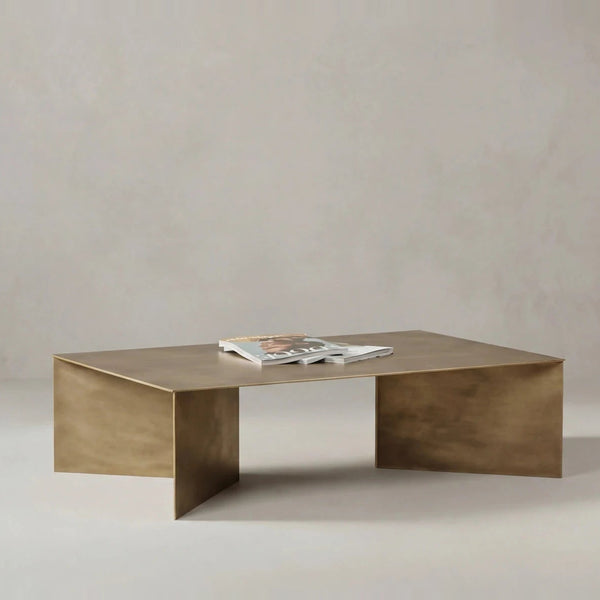
In dry living spaces, both grades are sufficient. The Informationsstelle Edelstahl Rostfrei assigns 1.4301 to a corrosion class intended for applications without significant exposure to chlorides or sulphur dioxide [2]. A shelf in the study or a coffee table in the living room therefore asks little of its metal; there, whether it is V2A or V4A hardly affects how the surface behaves.
- Living room, study: both grades sufficient
- Dining area: table salt, food, frequent wiping
- Hallway: moisture and road salt from shoes and umbrellas
- Without sealing: the grade protects on its own
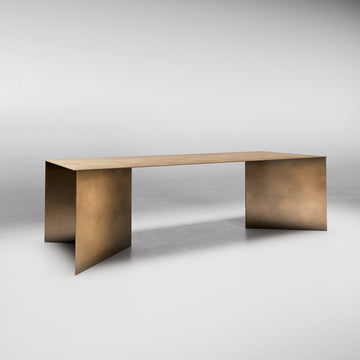
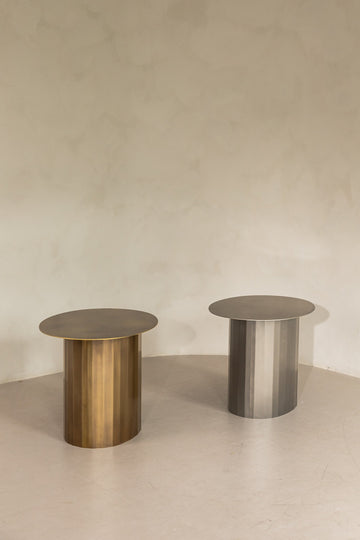
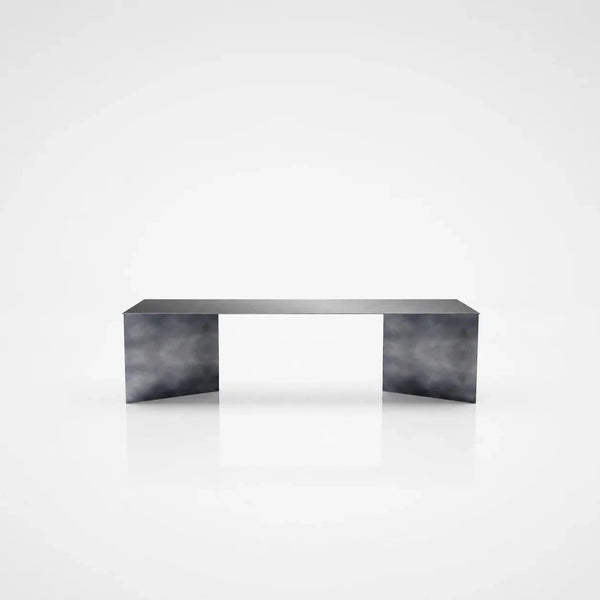
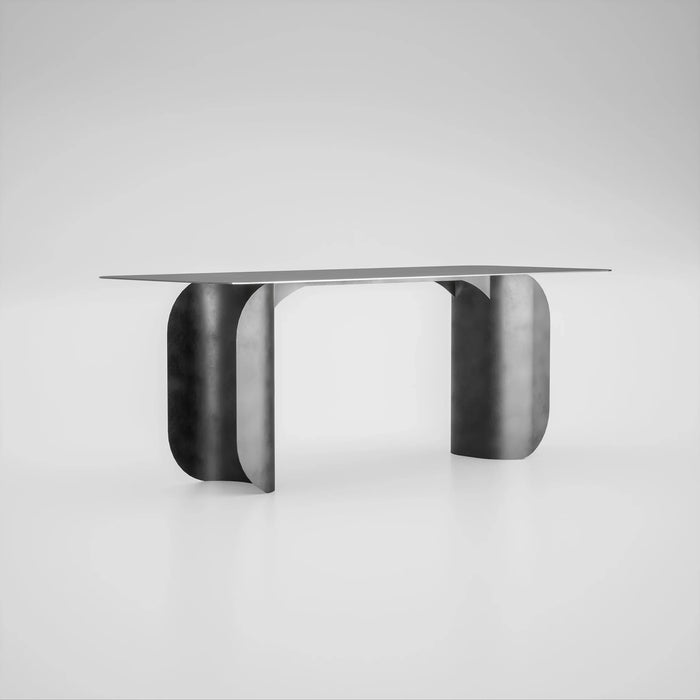
The dining area is different. Table salt, salty food and splashes end up on a dining table, and its top is often wiped with a damp cloth. Table salt is sodium chloride, precisely the substance against which molybdenum arms stainless steel. For dining tables such as SAMURAI, SATORI or ZEN DINING TABLE, the difference between V2A and V4A is therefore more than a line on a data sheet.
The same applies to the hallway. In winter, shoes carry in road salt and meltwater, and wet umbrellas lean against a console or a shelf. Where moisture and salt meet, the question of V2A or V4A becomes a question of reserve, and the grade with molybdenum has it. How the dining area and the hallway can be designed as rooms is shown in the articles Furnishing the dining room and Designing the hallway.
The workplace knows salt too, only in small amounts. At the OYAKATA desk, forearms and hands rest on the surface for hours, and hand perspiration contains salt. For a sealed top this is insignificant; for an unprotected material it is a quiet, constant task. If you choose furniture not for one particular room but for many years and changing rooms, V4A is the grade that rules out none of these places.
Mentioned in this article
Pieces from this article.


Stainless steel 1.4404: what ZinCuTec furniture is made of
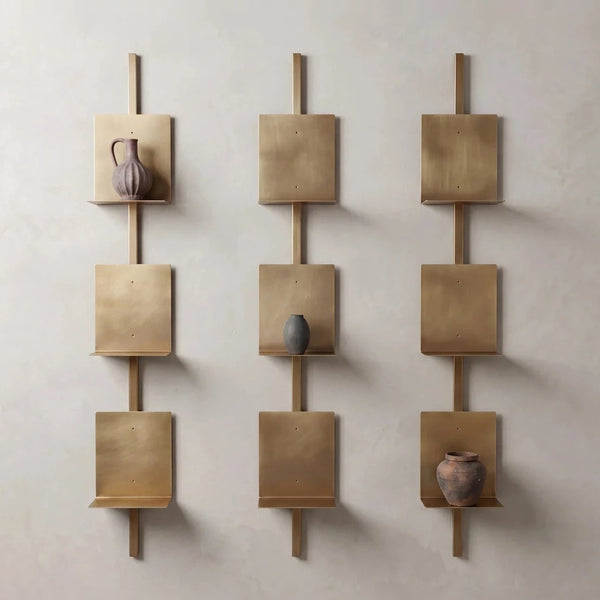
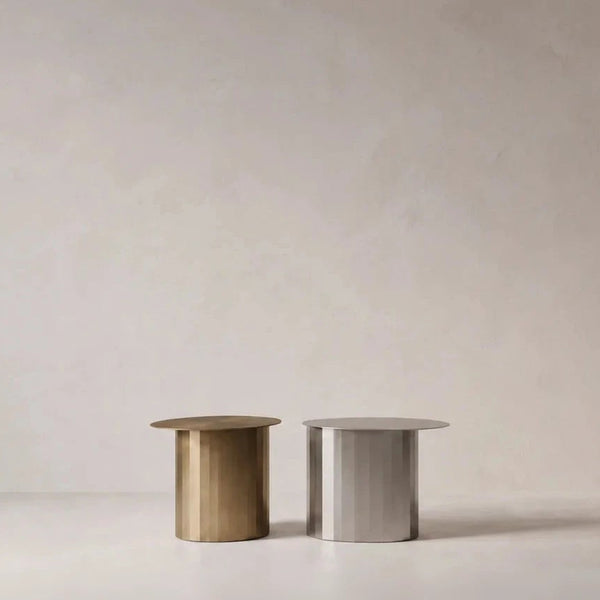
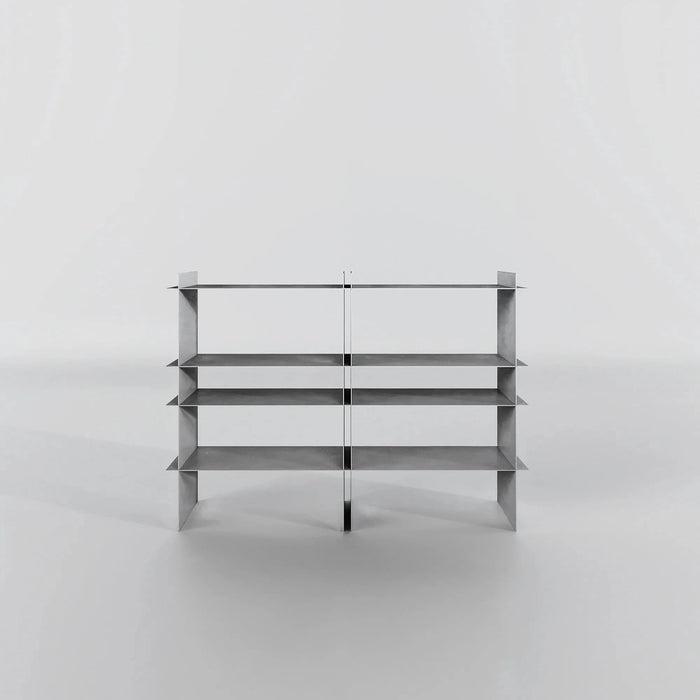
For its stainless steel furniture, ZinCuTec uses grade 1.4404, in other words V4A [1]. The dining tables are made from the same grade as the TAISHO shelf. With these pieces, the question of V2A or V4A therefore does not arise: the grade with molybdenum is a given, in a dry study just as at the dining table.
The grade is fixed before the first sheet meets the shears. What happens afterwards in the workshop, the bending, the joining, the grinding, changes the form, not the material. There, 1.4404 becomes an object whose edges and surfaces are guided by hand; the molybdenum travels along invisibly.
- Material: stainless steel 1.4404 (V4A)
- Surface: brushed and sealed, tables with 2K clear lacquer
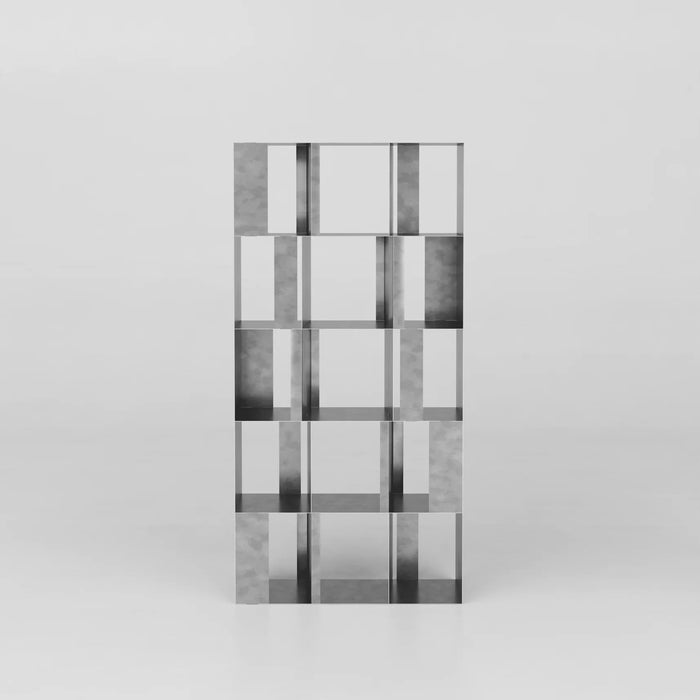
- RAW: INFINITY BOOKSHELF, without sealing
- Brass: CuZn37
The sealing lies over the material. Every piece of ZinCuTec furniture is sealed, every table receives a 2K clear lacquer [1]. The transparent lacquer lies over the brushed grain and is the first layer that salt and moisture encounter; the resistance of the stainless steel works beneath it.
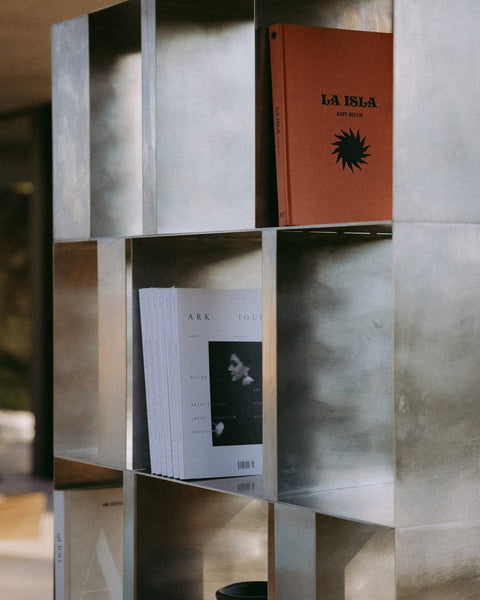
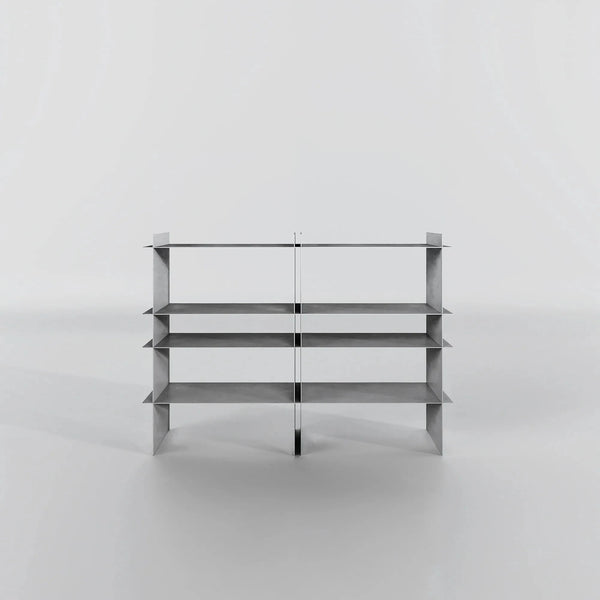
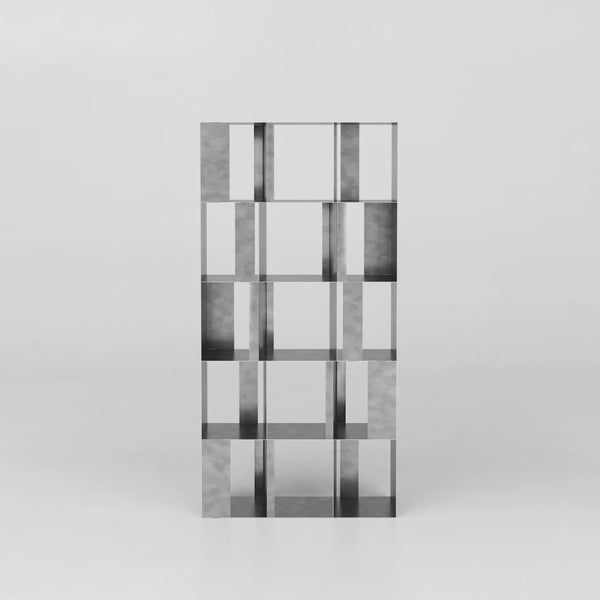
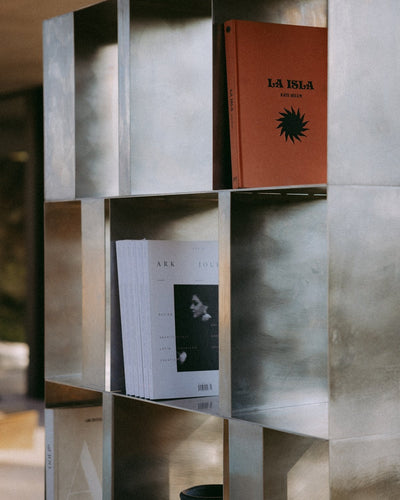
The INFINITY BOOKSHELF is an exception. Its modules are left RAW, without sealing [1]. Here the passive layer provides protection on its own, and it is precisely on the unprotected material that the difference between V2A and V4A takes direct effect. How the modules are cleaned is described in the notes on the Care page.
The workshop processes brass as CuZn37 [1]. How the two metals look in a room and how they can be combined is shown in the article Warm or cool: brass and stainless steel in the room; how brushing, burnishing and RAW guide the light, in the article Metal surfaces compared.
After the meal, a trace of salt remains on the tabletop. A damp cloth takes it up, a dry one follows. Beneath the lacquer, two percent molybdenum quietly does its part.
Frequently asked questions
What is the difference between V2A and V4A?
V4A additionally contains 2 to 2.5 percent molybdenum, V2A does not. Both are austenitic chromium-nickel steels and are considered stainless. Molybdenum makes V4A considerably more resistant to chlorides, for example from salt. Typical grades are 1.4301 (AISI 304) for V2A and 1.4401, 1.4404 (AISI 316L) and 1.4571 for V4A.
Is V4A better than V2A?
Not in general, but more resistant where chlorides occur. In dry interiors, both grades do their job. At the dining table, in a hallway with road salt or in places with salt and moisture, V4A offers the greater reserve. Neither grade is resistant to seawater.
Can V4A rust?
Yes, under unfavourable conditions. High chloride concentrations, such as saturated salt solution or seawater, can trigger pitting corrosion. Extraneous rust is more common: particles of ordinary steel, for example grinding dust or abrasion from steel wool, rust on the surface. It does not come from the stainless steel itself and can be removed with suitable products.
Is V2A or V4A magnetic?
In the solution-annealed state, both grades are largely non-magnetic. Cold forming, for example during bending, can create slight magnetisability; a higher nickel content, as in 1.4404, reduces this tendency. A magnet is therefore not suitable for determining the grade.
How can you identify V4A stainless steel?
Not reliably by eye, because brushed surfaces of V2A and V4A look the same. The material number in the manufacturer's specification or the mill certificate is reliable, as is a material test in a laboratory. With ZinCuTec furniture the grade is known: stainless steel 1.4404.
What is the difference between steel and stainless steel?
Ordinary steel is an iron-carbon alloy that rusts in humid air. What is called stainless steel in everyday use is steel with at least 10.5 percent chromium. The chromium forms a thin passive layer that protects the surface and renews itself after scratches.
What stainless steel is ZinCuTec furniture made of?
Stainless steel 1.4404, in other words V4A, with a brushed surface. All of them are sealed, tables with a 2K clear lacquer. The INFINITY BOOKSHELF is the exception: its modules have no lacquer and show the stainless steel RAW. For brass furniture, ZinCuTec uses CuZn37.
Sources & references
- [1]ZinCuTec GmbH: Produktangaben SAMURAI, SATORI, ZEN DINING TABLE, TAISHO und INFINITY BOOKSHELF (Material, Oberfläche, Ausführungen) sowie Seite „Pflege“, zincutec.eu, abgerufen am 13.10.2026; Werkstoffangaben Edelstahl 1.4404 und Messing CuZn37 sowie Versiegelung laut Herstellerauskunft vom 09.10.2026
- [2]Informationsstelle Edelstahl Rostfrei: Merkblatt 821, Edelstahl Rostfrei: Eigenschaften, 5. Auflage 2014 (S. 2 Mindestchromgehalt und Handelsnamen, S. 3 Tabelle 1 Zusammensetzung 1.4301 und 1.4404, S. 8 bis 9 Korrosionsklassen, S. 12 bis 13 Passivschicht, Chloride, Wirksumme, Abhängigkeit vom Medium, S. 19 Magnetisierbarkeit), abgerufen am 13.10.2026 edelstahl-rostfrei.de/fileadmin/user_upload/ISER/downloads/MB_821.pdf
- [3]Deutsche Edelstahlwerke GmbH: Werkstoffdatenblatt Acidur 4404 (1.4404, X2CrNiMo17-12-2, AISI 316L), Stand 08.06.2016, abgerufen am 13.10.2026 swisssteel-group.com/content-media/documents/Data-Sheets/Stainless-Steel/1.4404_de.pdf
- [4]Deutsche Edelstahlwerke GmbH: Werkstoffdatenblatt Acidur 4301 (1.4301, X5CrNi18-10, AISI 304), Stand 27.11.2015, abgerufen am 13.10.2026 swisssteel-group.com/content-media/documents/Data-Sheets/Stainless-Steel/1.4301_de.pdf
- [5]Wikipedia: „Nichtrostender Stahl“ (Abschnitte Synonyme, Befestigungsschrauben), abgerufen am 13.10.2026 de.wikipedia.org/wiki/Nichtrostender_Stahl
- [6]Informationsstelle Edelstahl Rostfrei: Merkblatt 824, Reinigung von Edelstahl Rostfrei, 2. vollständig überarbeitete Auflage 2024 (Abschnitt 4: Fremdrost, Chloride), abgerufen am 11.10.2026 edelstahl-rostfrei.de/fileadmin/user_upload/ISER/images/publikationen/iser_MB824_2025.pdf
How we work: journal articles are written in the workshop, checked by a specialist before publication and updated when something changes. Editorial principles
Read on
You might also like.

Burnished brass: why it is the burnishing that makes the metal precious
What happens in the metal during burnishing, how the patina is created in the workshop and why the sealing keeps it exactly as it was when it left the workshop.Read article
How to recognise high-quality furniture: eight details you can touch
Weld seam, edge, surface, weight: how the quality of a metal piece of furniture can be checked by hand before you believe a description.Read article