



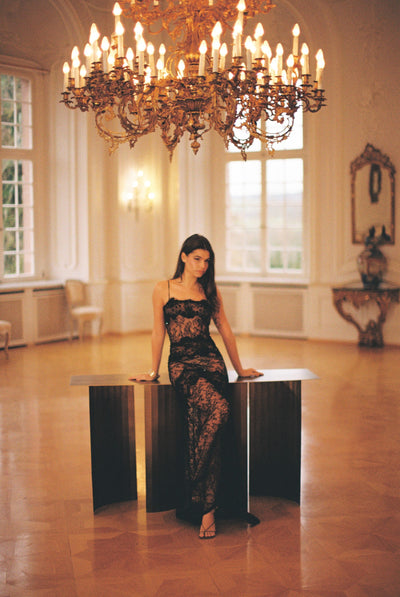
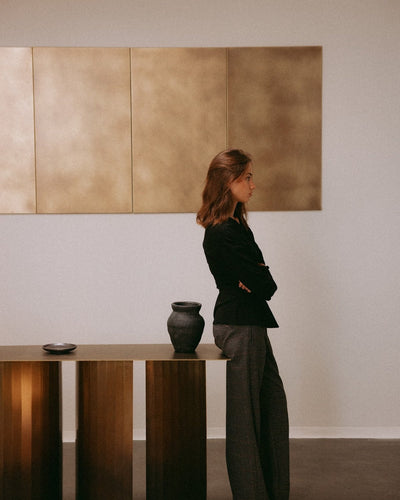
Brushed, burnished, raw: three finishes and what they do in a room
Three metal finishes, three ways of handling light: what distinguishes the brushed grain, the burnishing and the stainless steel left RAW, and where polished, ground and satin finishes fit in.

In brief
- ZinCuTec furniture comes in three metal finishes: brushed stainless steel, burnished brass and, on the INFINITY BOOKSHELF, stainless steel left RAW.
- At ZinCuTec, brushed stainless steel has a cloudy, low-reflection grain and looks bright, matt and calm.
- Burnished brass receives its dark, warm tone in the workshop; the sealing preserves it, and for tables this is a 2K clear lacquer.
- RAW shows the stainless steel with grinding marks, reflections and small irregularities from manufacturing and is the only finish that is not sealed.
- Ground, brushed and polished surfaces differ mainly in how strongly and in which direction they reflect; there is no polished surface in the range.
Contents
- 01Metal finishes: what the treatment decides about a piece of furniture
- 02Brushed stainless steel: calm through direction
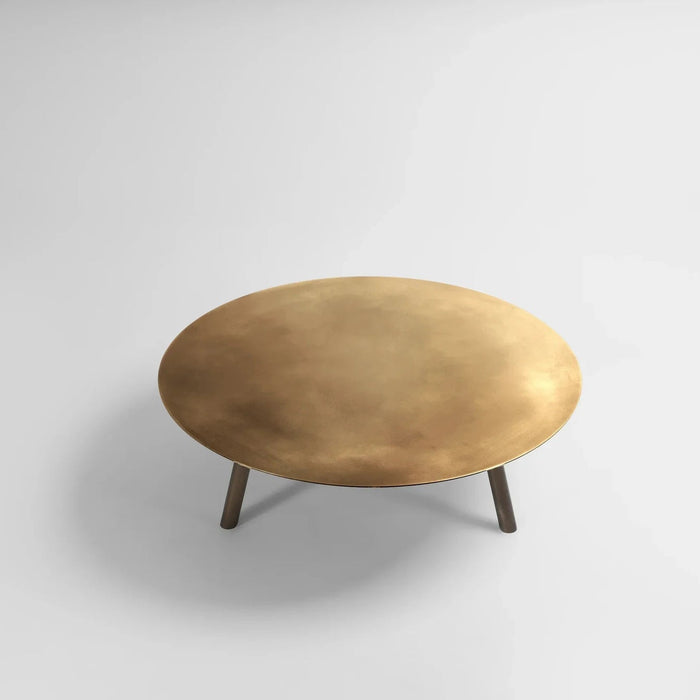
- 03Burnished brass: depth instead of shine
- 04Raw: stainless steel left RAW
- 05Ground, brushed, polished: how strongly metal mirrors
- 06Sealed: the layer you do not see
- 07Frequently asked questions
Metal finishes decide whether a piece of furniture makes a room brighter, warmer or more serious. The same form looks different in brushed stainless steel than in burnished brass, and a shelf that shows how it was made looks different from one with an even surface. At ZinCuTec there are three such finishes. Each has its own way of handling light, and each gives a room something different.
This article sets the three side by side: brushed, burnished and RAW. It explains how the surface treatment of metal determines the effect of a piece of furniture, where polished, ground and satin surfaces fit in, and what the sealing achieves.
Metal finishes: what the treatment decides about a piece of furniture
A sheet as it comes from the rolling mill is not yet a designed surface. Only surface treatment gives the metal an expression, and the processes for this can be roughly divided into three families. Mechanical processes such as grinding, brushing and polishing change the structure of the surface. Chemical processes such as burnishing change its colour. Coatings such as lacquer or powder lay a new layer over it that hides the metal or gives it a foreign colour.
- Mechanical: grinding, brushing, polishing
- Chemical: burnishing
- Coating: coloured or opaque lacquer, powder coating
For ZinCuTec furniture, the first two families are used. Stainless steel is brushed, brass is burnished, and afterwards both are sealed transparently, the tables with a 2K clear lacquer, the other objects with a 1K clear lacquer [1]. There are no coloured or opaque lacquered metal surfaces in the range; what you see is always the metal itself in a particular state.
The standard DIN EN 10088-2 distinguishes such states precisely for stainless steels. Among others, it lists ground, brushed, silk-matt polished and bright polished finishes and describes them according to whether their texture is directional and how strongly they reflect [2]. For a living space, this is precisely the decisive question: how much light does a surface give back, and in which direction?
Brushed stainless steel: calm through direction
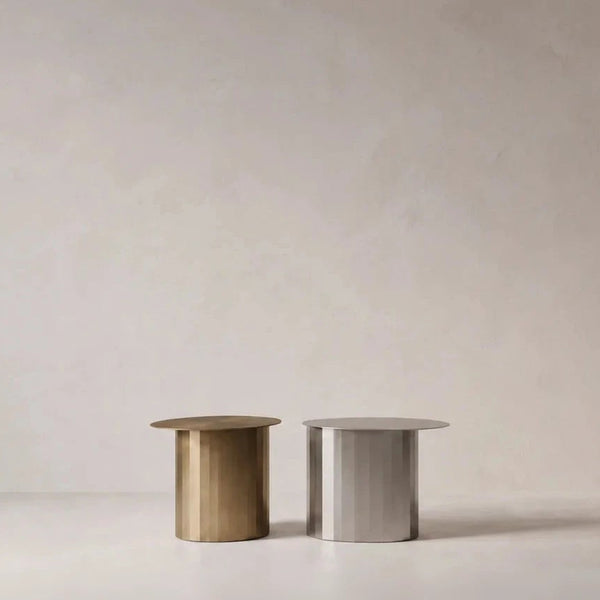
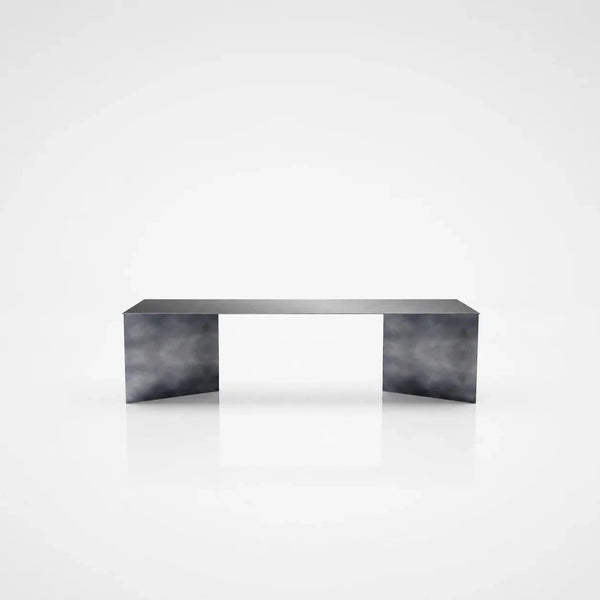
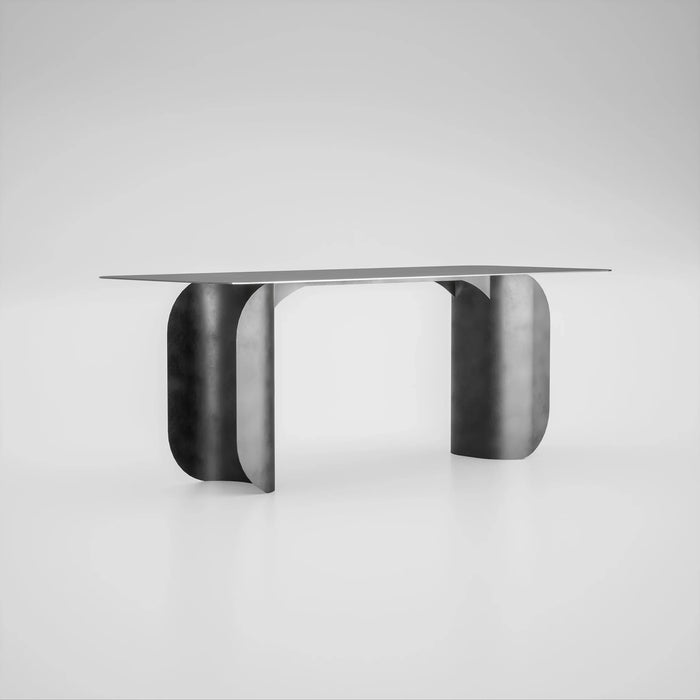
Stainless steel counts as brushed when its surface has been worked in one direction with brushes or polishing belts. This creates a fine, unidirectional texture that, according to the standard, is smoother than a ground finish and reflects little [2]. In the ZinCuTec workshop, the surface is created by alternating sanding belt, non-woven pad and brush, deliberately without a fixed direction: the grain is cloudy. The eye reads it as a matt, silky grey. Up close you can see the structure; from a few steps away the surface becomes still.
- Process: sanding belt, non-woven pad and brush, cloudy grain
- Effect: bright, matt, little reflection
- Objects: SAMURAI, TAISHO, ZEN COFFEE TABLE in stainless steel
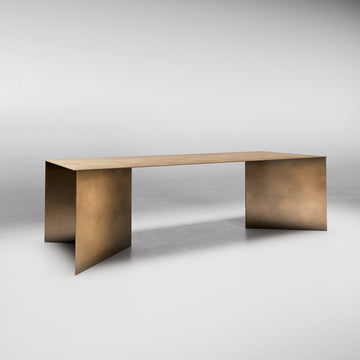
Among the metal finishes in the range it is the brightest, and in a room it has a clarifying effect. It is bright enough to open up a dark room and matt enough not to dazzle. On the top of the SAMURAI dining table, measuring 200 × 80 cm, the cloudy grain lies evenly over the entire surface and gives the table a calm that comes from uniformity. On the TAISHO shelf, the same grain covers the levels, and the compartments remain a background for what stands on them.
Looking after the surface is simple too: brushed stainless steel is cleaned gently with a soft cloth, with a little soapy water or alcohol-free glass cleaner if needed, as the article Cleaning brushed stainless steel describes in more detail. The choice of material 1.4404 (V4A) is explained in the article Stainless steel V2A and V4A in furniture.
Mentioned in this article
Pieces from this article.


Burnished brass: depth instead of shine
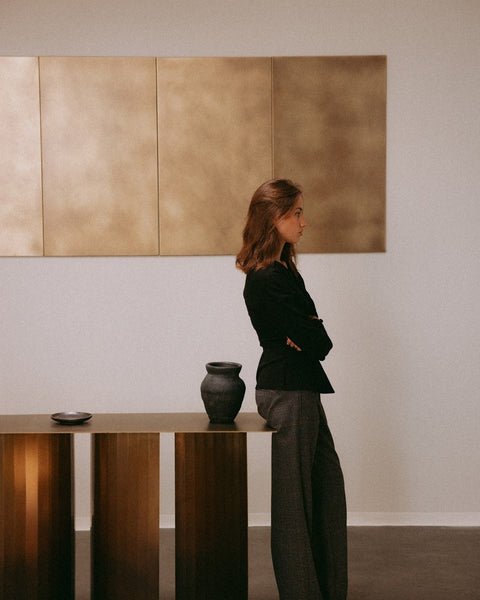
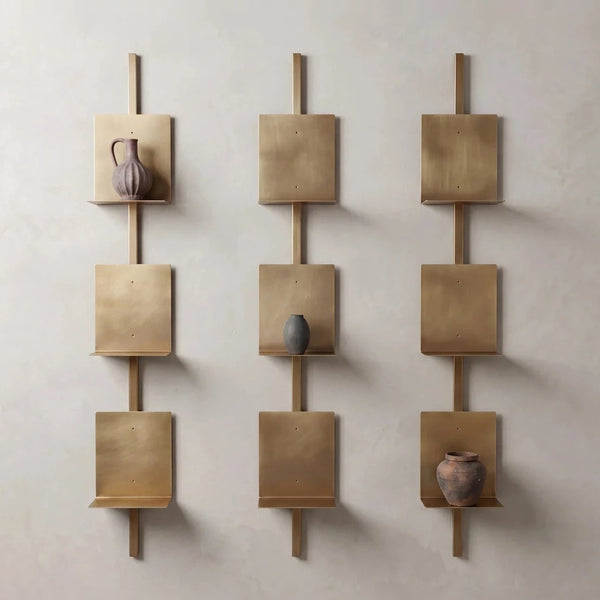
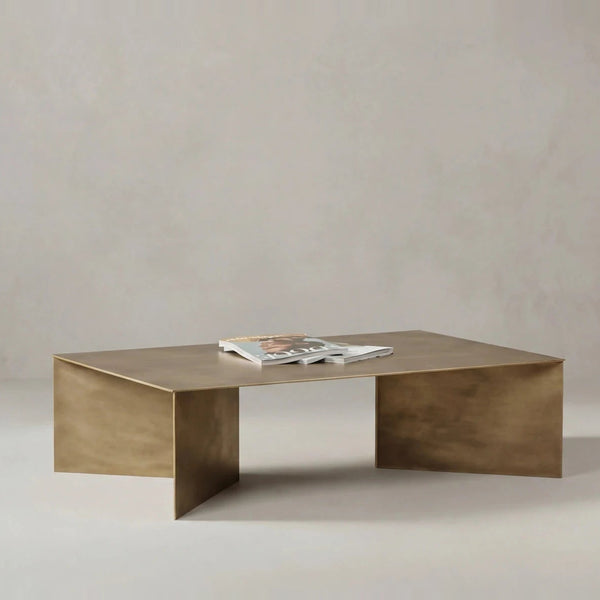
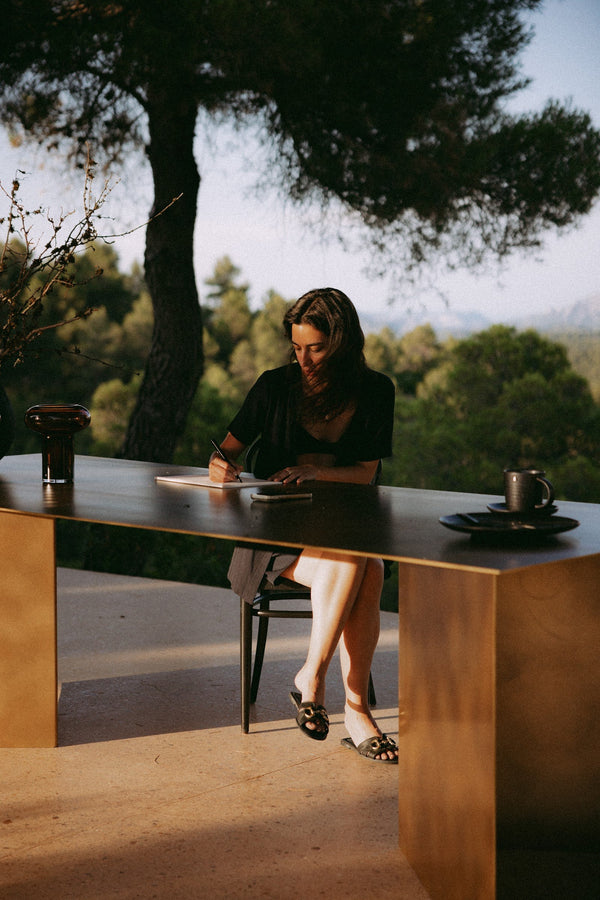
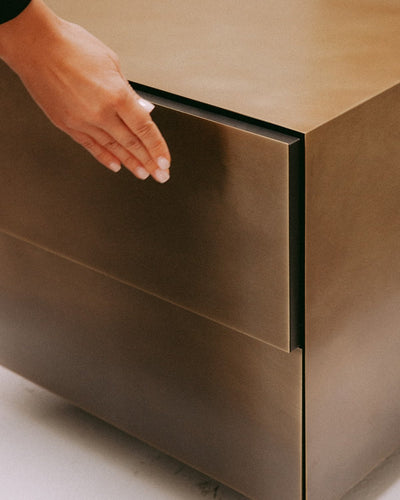
Burnished brass is the only one of the three metal finishes created by a chemical reaction. In the workshop, the top layer of the CuZn37 brass is deliberately oxidised until a tone between warm gold and dark brown is reached; it is then sealed, and the sealing preserves the patina created in this way [1]. How this works in detail and why it is only this step that makes the metal valuable is described in the article on burnished brass surfaces.
- Process: controlled oxidation in the workshop
- Effect: dark, matt, warm
- Objects: ELYSIAN, KANJI, ZEN COFFEE TABLE in brass
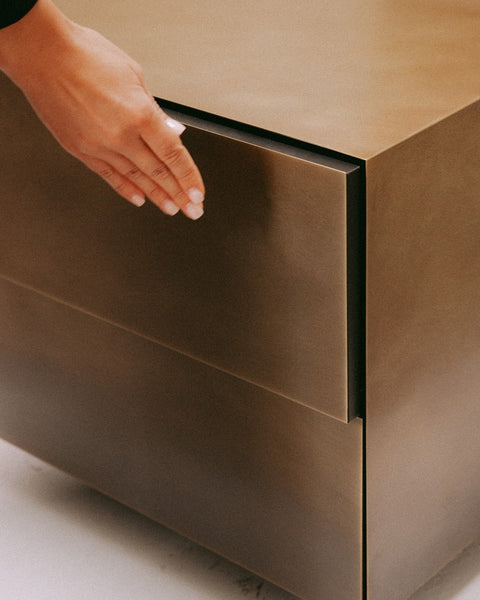
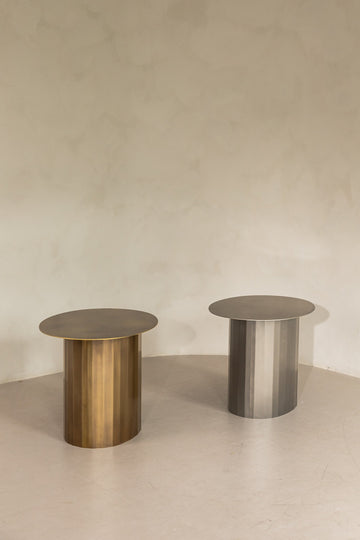
Next to brushed stainless steel, burnished brass is the darker and quieter surface. It reflects little and returns light with a warm colour; the edges stand out lighter and trace the outline of a piece of furniture. If you are looking for matt brass, burnishing is the real answer, because it takes the shine away from the metal without covering it. According to the product description, it gives the round coffee table ELYSIAN a deep, almost textile appearance [1].
Raw: stainless steel left RAW
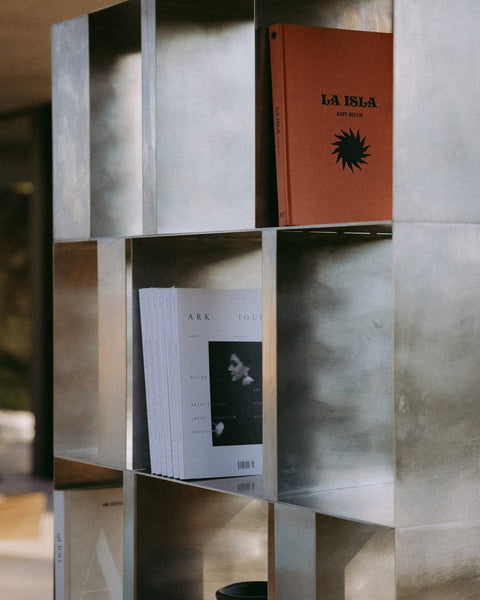
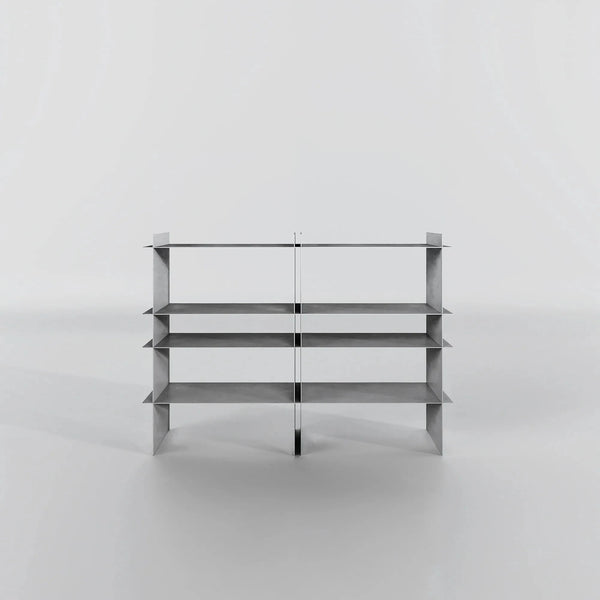
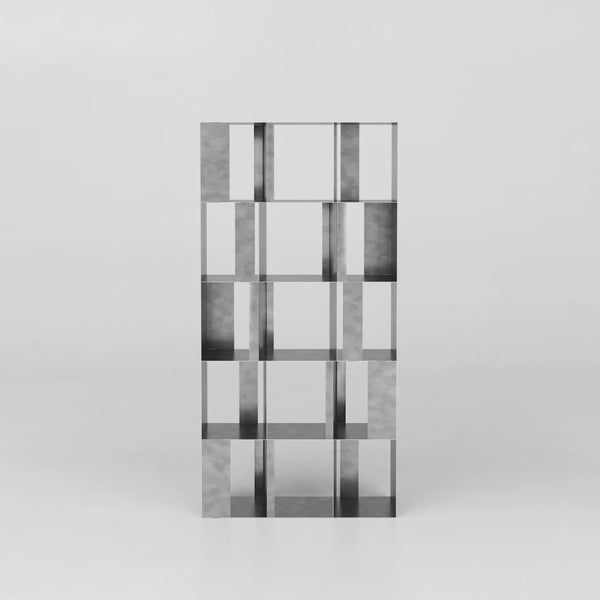
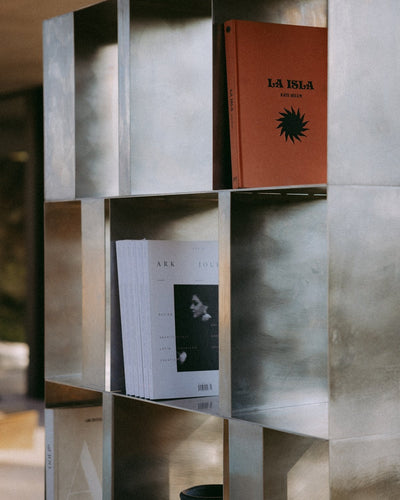
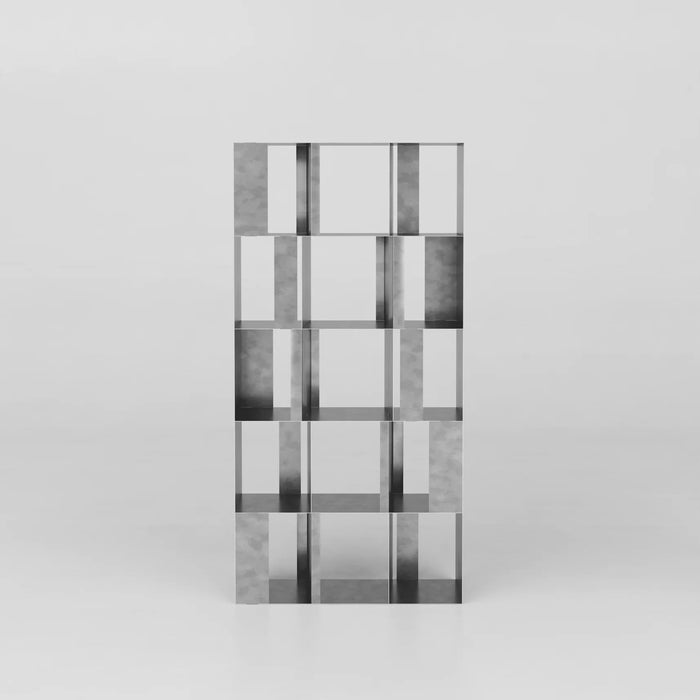
The third of the metal finishes is the most direct. On the INFINITY BOOKSHELF, the stainless steel is deliberately left RAW, and the traces of manufacturing remain visible: grinding marks, reflections of light, small irregularities [1]. The surface tells how the modules were made: each one 99.5 × 32 × 40.5 cm and made from a single component. That is precisely where its quality lies.
- Object: INFINITY BOOKSHELF
- Effect: lively, close to the workshop, open
- Special feature: the only object without sealing
RAW is the only finish in the range without sealing [1]. That stainless steel allows this is due to its passive layer, a very thin, invisible oxide film that forms by itself in air and, under many conditions, restores itself after a scratch [2]. Bare brass would not have this protection; it tarnishes in air. That is why there is no brass surface left RAW at ZinCuTec.
In a room, the surface left RAW looks livelier than the brushed one. Its reflections are more irregular, and it suits a system that can be put together anew again and again, as a bookshelf, as a sculpture or as a room divider [1]. If you want a piece of furniture to show how it was made, this is the most immediate form for it.
Ground, brushed, polished: how strongly metal mirrors
Comparing brushed and ground stainless steel means comparing two relatives. Both finishes have a unidirectional, low-reflection texture; the ground one is coarser, the brushed one smoother [2]. For the effect in a room, the difference is small. Both look matt, both show a direction, and both tend to let traces of use disappear into their structure more than a smooth surface does.
- Ground: directional, coarser, matt
- Brushed: directional, smoother, matt
- Polished: non-directional, highly reflective
Polished is the opposite. A bright polished surface has no direction; it reflects strongly and reproduces its surroundings with high image clarity [2]. A polished table becomes a mirror of the room and shows every lamp, every window and every touch. In between lies the standard's silk-matt polished finish. “Satin”, on the other hand, is not a term used in the standard; it usually refers to a fine, matt surface between brushed and polished.
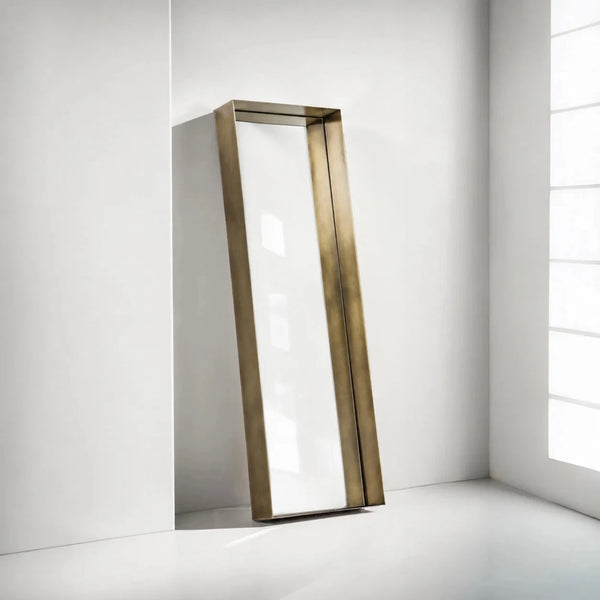
There is no polished surface in the ZinCuTec range. The objects rely on metal finishes that diffuse or absorb light, and leave the mirroring to the one object made for it: the REFLEXION mirror, whose glass is framed by burnished brass or brushed stainless steel [1].
Sealed: the layer you do not see
After the surface treatment, brushed stainless steel and burnished brass are sealed, the tables with a 2K clear lacquer, a transparent two-component lacquer, the other objects with a 1K clear lacquer [1]. The sealing changes nothing about the effect of the metal finishes; grain and burnishing remain fully visible beneath it. It protects the surface in everyday use but, according to the manufacturer's care instructions, does not make it scratch-proof, chemical-resistant or maintenance-free [1].
- Sealed: all objects except INFINITY BOOKSHELF
- Tables: 2K, objects: 1K clear lacquer
- Care: soft, slightly damp cloth
For care, this means: a soft, non-abrasive cloth, slightly dampened, with a little soapy water or alcohol-free glass cleaner if needed, then wipe dry, and no aggressive or abrasive cleaners [1]. On brass, the sealing preserves the tone with which the piece leaves the workshop; on stainless steel, the even appearance of the grain. How the two sealed metals look in a room when they stand side by side is described in the article Warm or cool: brass and stainless steel in a room.
Brushed, burnished and RAW are three answers to the question of how much a metal should reveal of itself. Brushing makes stainless steel bright and calm, burnishing gives brass depth, and RAW lets the stainless steel tell how it was made. In the end, it is the daylight in a room that shows where each of these metal finishes belongs.
Which objects are available in which finish is shown on the Designer furniture page.
Frequently asked questions
What is brushed stainless steel?
Brushed stainless steel is rust-resistant steel whose surface has been worked in one direction with brushes or polishing belts. This creates a fine, unidirectional texture that reflects little and looks matt; the standard DIN EN 10088-2 lists it as “brushed or dull polished” (designation 2J for cold-rolled sheet). At ZinCuTec, all stainless steel objects except the INFINITY BOOKSHELF are brushed, with a cloudy grain, and sealed.
Which is better, brushed or polished stainless steel?
That depends on the effect you want. Polished stainless steel is non-directional and highly reflective; it reproduces its surroundings clearly, and fingerprints are very noticeable. Brushed stainless steel is matt and reflects little, and traces of use stand out less in its structure. At ZinCuTec, the stainless steel furniture is brushed; there are no polished surfaces in the range.
What is the difference between ground and brushed stainless steel?
Both finishes have a unidirectional, low-reflection texture. Ground stainless steel (designation 2G) is coarser, its appearance determined by the grit of the abrasive. According to the standard, brushed stainless steel (2J) is smoother than ground and therefore looks silkier. In a room the difference is small: both look matt and show a direction.
What does “satin” mean for stainless steel?
“Satin” is not a term used in the standard. It usually refers to a fine, matt surface between brushed and polished. Within this spectrum, DIN EN 10088-2 includes the silk-matt polished finish (designation 2K), which is subject to additional requirements for corrosion resistance. In the ZinCuTec range, stainless steel is either brushed or left RAW.
Can stainless steel be patinated?
Stainless steel does not form a patina like copper or brass. Its surface carries a very thin, invisible oxide film, the passive layer, which forms by itself in air and protects the metal against corrosion. Dark or coloured tones on stainless steel only come about through dedicated surface-engineering processes. At ZinCuTec, stainless steel is brushed or left RAW; the patina arises exclusively on brass, through burnishing in the workshop.
How are the metal surfaces of ZinCuTec furniture treated?
Stainless steel 1.4404 is brushed, brass CuZn37 burnished in the workshop. Afterwards both receive a transparent sealing, tables a 2K clear lacquer, the other objects a 1K clear lacquer, beneath which grain and patina remain visible. Only the INFINITY BOOKSHELF, whose stainless steel is left RAW, remains unsealed. There are no coloured or opaque lacquered surfaces in the range.
What does RAW mean for the INFINITY BOOKSHELF?
RAW means that the stainless steel of the shelving system remains without a final sealing after manufacturing. Grinding marks, reflections and small irregularities from production remain visible and are part of the modules' character. The surface is protected by the passive layer that stainless steel forms by itself in air; the manufacturer's general care instructions apply to cleaning, and the modules may also be wiped with a wet cloth.
Sources & references
- [1]ZinCuTec GmbH: Produktangaben SAMURAI, TAISHO, ELYSIAN, INFINITY BOOKSHELF, REFLEXION und ZEN COFFEE TABLE sowie Gewährleistungs- und Pflegehinweise (Stand 10. Juli 2026), abgerufen am 11.10.2026 zincutec.eu/pages/pflege
- [2]Informationsstelle Edelstahl Rostfrei: Merkblatt 985, Reflexionseigenschaften von nichtrostendem Stahl, 1. Auflage 2018 (Tabelle der Oberflächenausführungen nach DIN EN 10088-2, Passivschicht), abgerufen am 11.10.2026 edelstahl-rostfrei.de/fileadmin/user_upload/ISER/downloads/MB_985.pdf
How we work: journal articles are written in the workshop, checked by a specialist before publication and updated when something changes. Editorial principles
Read on
You might also like.

Burnished brass: why it is the burnishing that makes the metal precious
What happens in the metal during burnishing, how the patina is created in the workshop and why the sealing keeps it exactly as it was when it left the workshop.Read article
How to recognise high-quality furniture: eight details you can touch
Weld seam, edge, surface, weight: how the quality of a metal piece of furniture can be checked by hand before you believe a description.Read article